Showing posts with label Rif War. Show all posts

Wednesday, 4 March 2026

Capitan de la Mano de Plata

Capitan de la Mano de Plata 


This piece was inspired by our recent visit to the Museo Historio Militar in Valencia where I can across the prosthetic arm of Captain Ripoll and just had to learn more, I hope you find it interesting.

Antonio Ripoll Sauvalle was born in Cartagena (Region of Murcia) in January 1881 and died in combat at the age of 28, on September 30, 1909, in Zoco el Jemis de Beni-Bu-Ifrur (Melilla, Morocco). A Spanish soldier decorated with the Laureate Cross of San Ferdnando, he fought in the Philippines and in Morocco where he met his death.

The son of Lieutenant Colonel of Artillery of the Navy: Luis Ripoll y Palau and Micaela Sauvalle Gil de Aballe. Antonio entered the Infantry Academy of Toledo at the age of 14 and graduated as a Second Lieutenant, at the age of 15 in September 1896. He was assigned to 2nd Battalion of Espana Infantry Regiment No46 which garrisoned in Cartagena.

Cadet Antonio Ripoll Sauvalle cerca 1895

In November 1897 he volunteered to serve overseas and was assigned to the Philippine Army, at his own request, traveling on the steamship Leon XIII, arriving in the islands` capital on December 5th. He was stationed in various locations during 1898: Bianobacto, Bulacon and Manila; where he participated in operations against the insurgents. At the begining of August of the following year, he was promoted to First Lieutenant for his Bravery and outstanding performance during the fighting in the Siege of Manila against the Yankee invaders.

On August 13th, while serving with 3rd Company of 2nd Battalion during the retreat to the city, he was shot in the legs and left wrist, fracturing his ulna and radius! He was admitted to the Old Seminary Hospital in Manila, where the severity of the wound necessitated the amputation of his left forearm halfway between the elbow and wrist. For his actions during the retreat, he was promoted to captain - he was still only 17 year old! This made him the youngest captain in the Spanish Army, he was also awarded the Red Cross Medal for Military Merit. 

A few panels from Antonio Hernandez Palacios comic strip
                                                                 Capitan Ripoll cerca 1900

Due to his disability, on November 27th he boarded the buenos Aires bound for Barcelona, arriving on December 7th. He always wished to remain on active duty and not join the Invalid Corps (where with his record he would most likely have risen more quickly through the ranks). He requested an interview with the Queen Regent - Maria Cristina to whom he begged to remain on active duty, she not only granted Ripoll`s request but also ordered that an aluminium prosthetic arm be made for him and once fitted he was reassigned back to his former regiment - Espana No46 stationed in his home city of Cartagena. 

 Queen Regent - Maria Cristina

In 1909, when the Second Melilla War began, at his own request, he was again assigned to Melilla, to the Figueras Battalion. The conflict pitted Spanish troops against the savage Moroccan Rif tribes between July and December 1909, in the vicinity of the city. A treaty signed with France in 1904 granted Spain free rein for colonial expansion into northern Morocco. This was a highly desired aspiration of the Spanish government and army as compensation for the loss of the remnants of its empire six years earlier. Silver-bearing lead and iron mines were discovered, which both nations, signatories to the treaty, set about exploiting. To this end, the concessions included permission to build a mining railway to transport the ore from the mines to the port of Melilla. Unfortunately the mining concessions were not to the liking of the local tribes and in October 1908, they began a rebellion harassing the Spaniards who worked in the mines, even bringing the mining train to a standstill!

The concessionary companies pressured the Spanish Government to deploy the garrison troops in Melilla so that they could continue with the operation. Construction of the railway resumed on June 7th, but two days later, a group of Spanish workers were shot working on the railway line which linked Melilla and Beni-Bu-Ifur at the Sidi Musa ravine bridge, resulting in four workers being killed, this attack triggered the Melilla War.

In July (26 – 27) General Guillermo Pintos Ledesma managed to get himself and 153 of his officers and me killed (and another 564 wounded) at Barranco del Lobo! On the 30th of the same month, a reconnaissance operation was carried out from Zeluan to the Zoco el Jemis of the Kabila of Beni- Bu-Ifrur, in the mining area on the northern slope of the Gurugu Massif. The action was carried out by a column of troops from the 1st Division under the command of General Díaz Vicario. In a fierce engagement with the enemy, they managed to halt the advance after inflicting nearly 300 casualties, including 40 dead, among them the commanding general himself. With cavalry support, the staggered withdrawal of the forces was ordered.

Capitan Ripoll cerca 1905 

Capt. Ripoll who due to his metal left hand, had now earned the nickname “Capitan de la Mano de Plata” (Captain Silver Hand) – though he always wore a leather glove over the aluminium hand; had volunteered immediately for active duty as soon as he heard about possibilities of action! He was assigned to the Figueras Battalion No6 and given command of battalion`s 4th Company.

During the retreat from Zoco el Jemis, Capt. Ripoll`s company was the last to retreat, it came under heavy fire from a house situated on a hilltop. The captain knew he had to dislodge the enemy from the house, so he gathered two sections of his men and ordered them to deploy and fix bayonets! So at the head of just two sections, he attacked the entrenched, tenacious enemy, who by eye witness accounts also outnumbered the Spanish! Capt. Ripoll was seriously wounded in the chest while advancing, but this did not stop him from leading the troops. He encouraged them and led by example, at one point throwing himself alone onto a group of Moors entrenched in some prickly pear cacti, so savage was his attack, that he drove the Riffi out of their position in panic! Soon after however the brave Captain was hit again, this time in the abdomen, then a third time, in the head which killed him! His men were unable to recover thier officer`s body due to enemy fire and were forced to retreat!

A page from Juan Cámara`s comic strip

Some fifteen days later on October 14th, a search team found the Captain`s body which had been badly broken by the vengeful Berbers and his silver hand was missing, taken as a trophy by the enemy! However two days later Caid Amar of the Beni Urriaguel tribe returned the arm/hand to the Spanish as a sign of admiration for a fallen, brave enemy. Captain Ripoll`s body was buried with full military honours at Zeluán cemetery. 

When he died, Captain Ripoll was only 28 years old, married to Concepción López Martínez and they had two children: Luis and Micaela. 

Captain Ripoll`s commanding officer Lieutenant Colonel Burguete, said of the Captain:

"The History of Spain has been made by one-armed men. One-armed Cervantes, one-armed Ripoll... We must all wish that we were missing a hand, because if we have all our arms we cannot aspire to great glories."

The “silver” hand was taken to the Infantry Museum at Toledo and put on display.

The Cartagena City Council, in its session of October 5, 1909, agreed to name a street "Ripoll-Milvaín", to honor his memory as well as that of his half-brother, Eduardo Milvaín Sauvalle, who died gloriously in 1896 in the Cuban wilderness.

Captain Ripoll was recognition of his heroic actions posthumously promoted to the rank of Commander and awarded the Laureate Cross of San Fernando 2nd Class by Royal Order (June 7, 1911).

"Having reviewed the file of the contradictory trial, initiated to determine whether Infantry Captain Antonio Ripoll y Sauvalle was entitled to the Cruz Laureada de San Fernando, for the merits acquired in the combat of September 30, 1909, in el Zoco el Jemis de Beni-bu-Ifrur (Melilla), in which he died gloriously (…) in accordance with the report of the Supreme Cpuncil of War and the Navy in Plenary, and by resolution of this date, it has been seen fit to grant Infantry Captain Antonio Ripoll Sauvalle the Cross of the second class of the Order of San Fernando with the annual pension of 1,500 pesetas, which may be received by the persons of his family to whom it corresponds according to the provisions of article 11 in law”

Also in 1911, coinciding with the awarding of the Laureate Cross of San Fernando, his graduating class commissioned the creation of a medallion for the Infantry Museum, designed by Infantry Commander José Martínez Oteiza and cast by the Duro Felguera Metallurgical Society, which offered to make it free of charge.

Commorative medalion as mentioned in the text

In August 1920, almost eleven years after his heroic death, King Alfonso XIII took an interest in the hero and ordered recovery of the remains of Commander Ripoll. These remains were transferred from Zeluán to the Purísima Concepción Cemetery in Melilla. It was ordered that he be buried in niche number 1 of the first row of the Pantheon of Heroes, where he has rested ever since!

Post script

The Cartagena City Council's restoration workshop continues its work recovering the holdings of the municipal art gallery. The workshop director,  Isidro Pérez, has just completed the restoration of the  portrait of Cartagena-born Commander Antonio Ripoll, painted by the artist Francisco Portela. (News report dated: Tuesday 27 September 2022)

Commander Ripoll`s son a Lieutenant of Engineers, Luis Ripoll López (born 1908) was also a recipient of the Laureate Cross of San Fernando! He died heroically leading his men during the Battle of Jarama in 1937!

Teniente Luis Ripoll López (note the engineers badge on his collar)

Whilst trawling the internet,  I found two comic strips based on the life (and death) of commander Ripoll (sample pages above). The first drawn by artist Antonio Hernandez Palacios; the second published in El Faro, written and drawn by Juan Cámara and published by the Center for Military History and Culture of Melilla.


Thursday, 1 January 2026

Battle for the Crag (New photos and more info on the evacuation added 01/01/2026)

Battle for the Crag

Penon de Velez de la Gomera, March – April 1922 

An earlier version of this article appeared in the magazine of the Society of Twentieth Century Wargames (SOTCW) The Journal

Penon (crag) de Velez de la Gomera is a small offshore island located 119 km (72.7 miles) southeast of Ceuta. It is a steep rock island with a length of 400 meters northwest-southeast and a width of up to 100 meters, and a height of 80 meters above the sea, it covers about 19,000 square meters in total. There is another smaller island linked to its larger neighbour by a wooded bridge. The islands are situated only 85 meters from the Moroccan shore and can be easily reached by foot at low tides.


Initially captured by Spain in 1508 when an expedition under the command of Pedro Navarro was sent to destroy the pirates who populated it, and who were constantly attacking and looting the coast of Southern Spain. The expedition was successful and Spain captured the Penon, but they lost it again in 1522 after a successful Berber attack, in which the whole Spanish garrison was slaughtered. In 1564, after some failed attempts, the Spaniards re-conquered it and they have retained control of it ever since, despite having been besieged on several occasions.

The main island is covered in the remains of ruins from centuries of fortifications, built one on top of another. There is little or no plant life and no source of fresh water, though the Spanish built good cisterns. The island was for many years used as a penal colony with prisoners forced to work for mining and farming interests on the Moroccan mainland.

The Riffi attack – March 22, 1922

The Penon was garrisoned by a company of men from the Regiment de Infantries de Africa No68 commanded by a captain. The garrison also had two small cannon and one machine gun. Apart from the garrison there were also a number of prisoners and civilians on the Penon including wives and families of officers.

After dark on March 22, the Riffi using small boats silently approached the small island. They managed to scale the rock without being spotted and then without warning swarmed over the parapet and attacked the soldiers stationed there. The garrison was alerted by gunfire and rushed to man the main defences, just in time, it was low tide and the Riffi were attacking the main island from the shore. Other Riffi tried to cross the connecting bridge between the two islands or fired at the defenders from their vantage point. The Riffi main attack was beaten off, but the captain was killed and several members of the garrison also casualties. 

Things were so grim that orders came down for the civilian families and seriously wounded were to be evacuated off the Penon by naval submarine! The mission fell to Lieutenants Casimiro Carre Chicarro & Francisco Regalado Redriguez, respectively commanders of submarines Isaac Peral (American built) and B-1 (one of the first home built Spanish boats). The two boats slipped into the bay at night and docked at the Penon, they managed to rescue 66 people the first night, then slip back in and rescue a further 37 the next!


Two photos of El Isaac Peral alongside the cruiser Cataluna

Officers and men of the B-1

The situation on the Penon got steadily worse with the defenders under constant rifle and occasional cannon fire until early April (actual date not clear) when volunteers from La Legion chosen by lottery from the best shots among the various companies where transported aboard the steamship Bustamante by sea from Melilla. 
El Bustamente (colourised and enhanced)

Once the relief party arrived: Lieutenants – Jose Martinez Esparza and Alfreez Diaz de Rabago with one sergeant, six corporals and forty-four legionnaires. They immediately took over the defences moving into the forward positions on the rock. The next morning the legionnnaires launched a direct frontal assault on the smaller island driving the Berbers off at bayonet point. With the arrival of the legionnaires upon the Penon, the enemy’s ardor diminished and although they continued to harass the defenders they never again attacked in force.
Period photo with Lt. Esparza centre front.

The Game
For the purposes of our game, we decided to ignored the civilians and start at the point where the Riffi were already occupying the smaller island and are making their final all out attack. The Spanish garrison was alerted and had called for reinforcements which were on the way by ship.

 It was decided that the ship with the Legion reinforcements would arrive by sea at 1D6 turns + 5 (much to the boys horror a 6 was rolled).

My representaion of The Crag

Spanish defenders

HQ

Captain, lieutenant, NCO, radio operator, 3 runners 

Reduced Rifle company

2 – 9 man platoons (rifles, 1 grenade each)

Support weapons

65mm mountain gun + crew (12 rds)

Hotchkiss MMG + crew

Riffi attackers

Main body (attacking from the beach and island)

4 -5 groups of warriors – 10 men each (rifles & knives)

 2 fishing boats

Each with 7 warriors (rifles & knives)

Reinforcements

El Bustamante armed trawler/gunboat

Armed with a 4pdr & 2 Hotchkiss MGs

 Half company La Legion

Officer, NCO, standard

2 – 8 man platoons (rifles, 2 – grenades)

LMG team

The Bustamante arrives just in time!

The game was a very close run thing, the Spanish defenders fire was unlucky, whilst the Riffi (me) kept rolling 6s. The Spanish slowly withdrew along the island, but were out of officers and virtually wiped out just as El Bustemente arrived! The ships crew used their MGs and 4pdr to good effect as the legionnaires scrambled ashore. Once ashore the battle-cry "Viva la Muerte!" was shouted and the two platoons with colours flying launched a bayonet charge into the remaining Riffi.

We played the game using 20mm figures from my collection. The Infanteria No.68 were mostly British Zulu War figures from Newline Designs with some Bandera and Irregular SCW. My Legion figures are a mix of Bandera, Irregular, Barcino and BUM SCW figures. My Riffi are Blitz Goumiers and Bandera/Irregular SCW Regulares with various plastic Arabs. El Bustamente is the Britannia Miniatures - Armed German Trawler, the crew are a mix of WW2 Kreigsmarine and Russian Naval Marines from Kelly’s Heroes; the Riffi fishing boats were Britannia British Naval Dorys.

Sources

The Betrothed of Death by Jose E. Alvarez
The Spanish Enclaves in Morocco by Robert Rezette
Article by Adolfo Ortigueira Gil in Serga No20 (Nov/Dec 2002) -
Evacuacion en el Penon (Spanish text)

An AAR plus photos of our game can be found here:

https://baberonwargames.blogspot.com/2012/07/penon-de-velez-de-la-gomera.html 

Friday, 14 November 2025

The Sacrifice of the Alcantara (update 14th November 2025)

 The Alcantara Cavalry Regiment and the Disaster at Annual 

Rif War, Morocco, July-August 1921 by Richard Baber

An earlier version of this article appeared in the magazine of the SOTCW - The Journal

The advance of General Manuel Fernandez Silvestre`s forces into the Spanish western zone from the old presidio Melilla towards Alhucemas Bay had started well enough.

Silvestre had around 25,000 men and was well supplied, unfortunately he was not a clever man who took little or no advice from his subordinates and even his superiors! As his columns advanced they built a large number of blockhouses plus fortified encampments and supply bases along their path; local tribes were paid off (but not disarmed). Silvestre decided to move further into the Rif than planned and, against the direct orders of General Damaso Berenguer Fuste, the Spanish High Commissioner of the protectorate, he crossed the Amekran River and built an outpost on top of Mt. Abarran, a holy site to the local Riffi.

Militarily Abd el-Krim who was trying to raise a rebellion against the Spanish must have welcomed the Spaniards advance into the Rif as it took them away from Melilla and stretching out their supply lines making them vulnerable. But then building a post isolated across the river from the bulk of the Spanish troops on top of a holy mountain which enraged the locals was a gift too good to ignore. His men acting with the aid of some native troops who betrayed their Spanish officers, attacked the outpost and nearly 200 Spaniards and loyal Regulares were killed; more importantly a battery of guns was captured along with large stocks of shells and small arms ammunition. Abd el-Krim used this success to gather more tribesmen to his banner with the promise of more victories and further loot.

What followed was a series of defeats that led one after the other, domino fashion, to one of the largest disasters to befall a European army in Africa. The next Spanish outpost to be attacked was Igueriben. Situated three miles from Annual this position was quickly surrounded and cut off from the main base. General Silvestre rapidly gathered what forces he had and rushed to Annual to rectify the situation. There followed several attempts to break the siege including two cavalry charges led by Silvestre himself, but heavy fire from Riffian artillery and machine guns drove back these brave efforts. The Riffians stormed Igueriben and in so doing managed to isolate and cut off General Silvestre and his men from Melilla, Annual being situated in a valley and Iguerben actually overlooks it and dominating its approaches.

On July 22nd, after several days with ammunition and supplies running dangerously low, General Silvestre gave the order to abandon Annual and for the Forces there in to try and fight their way back to the coast. What should have been an orderly withdrawal turned into a rout. Here accounts vary, with some stating that Silvestre was killed in combat, whilst others claim he committed suicide. Whatever the truth about the Spanish commander, his force was ill-prepared, and the Rifians fell upon the fleeing Spanish soldiers, civilians alike, slaughtering all they caught.

One of the units involved in Silvestre`s advance across the Riff was; Regimiento de Caballeria Alcantara No14 (transl: 14th Regiment of Cavalry “Alcantara”), commanded by Colonel Mandella. A veteran of the campaign, the regiment had served in Morocco for 10 years. It was a very well respected unit with a proud combat history, made up of mostly volunteers with a high level of training and discipline. Col. Mandella was actually with Gen. Silvestre at Annual when the General decided to abandon the town, he never returned to his command and was killed during the retreat. Command of the regiment fell to Lieutenant Colonel Fernando Primo de Rivera and Orbaneja (regimental 2nd in command), cousin of Lieutenant General Miguel Primo de Rivera who would become Dictator of Spain a few years later. The regiment had six squadrons (five sabre squadrons armed with sabres and carbines and a machine gun squadron), with a compliment of 32 officers and 685 men.

22nd July

The Lt. Col. himself led a squadron out to support an isolated post which protected a vital river crossing set in an high-sided gorge; if the position was lost, Izumar (the regiment's base camp) would be cut-off.

 Unfortunately the colonel was met with the sight of a flood of men withdrawing from Annual. An army in name alone, little command or control, units intermixed, men just looking to escape east in complete disorder. To his credit Col. Primo de Rivera did not abandon his duty, he quickly abandoned his patrol and gathered the rest of his regiment and began to organise the fleeing groups into some sort of order forcing them to move as one body with his squadrons and troops on the flanks effectively boxing them in. Once order had been regained, the regiment sent out parties to occupy strategic high ground, both on the flanks and in advance of the retreat. These parties fought short bloody actions to first clear and secure their positions; then held them until the straggling column had passed. This continued all day until, the column reached Ben Tieb, it is noted that many of the cavalrymen dismounted allowing wounded comrades from the column to be carried on their mounts.

 23rd July

At dawn the colonel began a general withdrawal towards the next major Spanish position - Dar Druis, first he sent 5th squadron with some light guns ahead of the main body to scout and drive off any Riffi already in position. He then sent a couple of troops to the River Kert to collect as much water as possible (I assume they had mules and pack horses). Finally once the main column was on the move, the colonel together with two squadrons and a battery of guns formed up as a rearguard screen. As the column straggled across the countryside, sections of riders fanned out to collect the troops from various posts: Ababda, Ain Kert, Azib o Midar, Cheif, Karra Midar and Tafersit. These fighting patrols often encountered Riffi and were forced to fight both to and from their objectives, casualties among the cavalry were high, but many Spanish troops were able to join the main column because of this sacrifice.

At the position called Cheif the column met another withdrawing column commanded by General Navarro, held up by a strong Riffi force. Col. Primo de Rivera led his men in a massed, mounted charge through rifle and machine gun fire; once through the lines; they wield around and charged back towards the enemies rear. These two ferocious charges forced the Riffi to break contact allowing the combined columns to move on and finally reach Dar Druis; but at the cost of over seventy casualties to Alcantara and many dead horses. In the same battle the Alcantara fought a proper mounted action against native Metalsa horsemen, Alcantara`s discipline and training drove the enemy cavalry from the field.

The road to Melilla was cut by the Riffi, a convoy of ambulances was shot up with many fatalities among the already wounded, drivers and medical staff. Upon getting this news, General Navarro seems to have lost his nerve and instead of digging in and trying to hold Dar Druis, he ordered the base evacuated and his command to withdraw to Mount Arruit via Batel.

Leading the withdrawal was of course Alcantara, though many men now carried wounds and almost all the horses were spent. But, the regiment (or what was left of it) continued to show great spirit and bravery, troops and sections moving out to clear Riffi from blocking positions and protect the more vulnerable column. At the Igan River (where the convoy of ambulances had been attacked earlier); the Riffi had dug in a strong blocking position. Col. Primo de Rivera called his survivors together:

 ""Soldiers, the hour of sacrifice has come. Let each one do his duty. If you do not, your mothers, your sweethearts, all Spanish women say they are cowards. We will show that we are not".

With that, supported by machine guns and a few cannon he led the remaining men (about two squadrons) in another mounted charge to clear the Riffi who were defending the ford. After a savage fight which included much hand-to-hand combat, the Alcantara broke through, drove off the Riffi and then held open the ford for the rest of the column pass through to Batel.

El Alcantara move forward protecting the flank of the straggling Spanish column 

20mm figures from the authors collection

When the Spanish finally reached Mount Arruit, Col. Primo de Rivera and the remains of his regiment continued to sally forth and harass the enemy. On July 30th, Lt. Col. Primo de Rivera`s left arm was severely lacerated by grenade fragments, but the colonel refused to abandon his command. Finally in a desperate attempt to prevent gangrene he ordered one of his officers to remove the arm and stuffed his handkerchief into his mouth to muffle his own screams whilst the operation was done without any anesthetics.

 Lt Col. Primo de Rivera died of his wounds at Monte Arruit a few days after the survivors arrived at the base, he was posthumously awarded the Distinguished Cross of San Fernando.

 This regiment literally fought itself to destruction as part of the rearguard, charging again and again into the teeth of the Riffian fire attempting to protect their comrades. When the retreat was over and the survivors paraded and a roll was called:

Of the four troop commanders – three were dead, the other a wounded prisoner.

Of the 29 other officers – 21 dead, 3 wounded, 2 prisoners (one wounded)

Six warrant officers – 5 dead

20 sergeants – 18 dead

63 corporals – 53 dead

13 trumpeters – all dead

14 farriers – 11 dead

17 privates 1st class – 14 dead

524 troopers – 403 dead

 Out of the entire regiment there was less than one full troop left! 

                                                                                                                                                    Post script

On July 2nd 2012, The Spanish government issued a Royal Decree (No 132) granting Armoured Cavalry Regiment No10 "Alcántara" the Distinguished Cross of San Fernando as a Laureate Collective. The award text reads:

  "For the facts carried in the days of July 22 to August 9, 1921, in the events known as the" Disaster of Annual where the unit fought heroically protecting withdrawal Spanish troops from positions Annual, Monte Arruit".


 Recreating the action on tabletop

Now I`m not into playing elites, I tend to run history, based games, but I have wanted to do this on tabletop for ages since the first time read about it.

 Scenario 1: Convoy escort

Set your table up with a windy track with wooded hills and deep wadis. The Spanish convoy start at one end and must exit the other. Either place or randomly generate warbands (Harkas) of Riffi along the trail to ambush this convoy. The troopers of Alcantara must protect the convoy at all cost, attacking any Riffi encountered or aggressively patrolling to keep the harkas away from the vulnerable convoy.

 Set a time limit for the Spanish (if you don`t cross the table by "X" the rearguard are overwhelmed and you all die!) and a casualty limit for the Riffi (too many casualties among your warriors will lose you loyalty among the tribes).    

 Scenario 2: Blocao relief mission

A couple of platoons from Alcantara are sent to bring back the garrison of an isolated blocao. Again a simple table with the blocao set at roughly halfway across.

The patrol from Alcantara must make their way to the blocao and then escort the garrison off the table. The Riffi could appear from random directions in varying numbers to make things interesting. The cavalry should be encouraged to act aggressively, but protect their charges at all costs. Bonus points for heroic acts, saving wounded, killing Riffi.    

Scenario 3: Massed battle

The Riffi have blocked the column, General Navarro calls upon the Alcantara to save the day "for the glory of Alfonso XIII and Spain"!

Set up the table with the Riffi set to block the columns retreat with entrenchments, using any buildings, farm walls, etc. The terrain can be as open or constricted as you want, but give the cavalry some opportunity for movement and charges.

If you give the Riffi any machine guns, limit the ammunition.

You could give Alcantara some artillery support (65mm mountain guns) as well as their own machine gun squadron. If your short of cavalry, have some of the saber squadrons start on foot. 

 Painting and figures

Alcantara cavalry wore an olive green uniform and floppy sun hat (like a jungle booney hat), some illustrations I`ve seen also show them in a light blue pillbox cap. All the colour sketches I have seen show the uniform colour to be similar to GW "Castellan green", I mix this with Vallejo "Russian Uniform Green"; brown leather webbing and pouches; badges were bronze, NCO stripes and officers stars bright yellow;  horse furniture was usually brown leather.

Typical cavalry uniform of the period note the blue cap

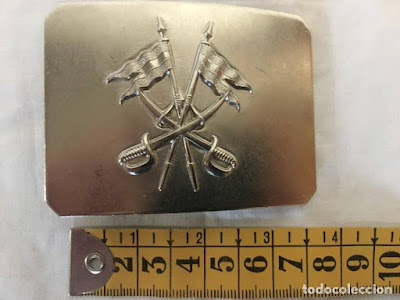
Cavalry belt buckle

Standard of the Alcantara

Mine are converted from Warrior Miniatures SCW mounted infantry and BUM (Barcelona Universal Models) SCW cavalry with Raventhorpe or Airfix (Confederate) heads. For foot figures use Liberation or Bandera SCW figures with sun hats

Sources

El Alcantara 1921 by Julio Albi

Rebels in the Rif by David S. Woolman

The Betrothed of Death by Jose E. Alvarez

La Legion 1921 by Francisco Martinez Canales

Les Imagenes del Desastre Annual 1921 by Antonio Carrasco Garcia

Uniformes de las Unidades Militares de la Ciudad de Melilla by Jose Maria Bueno Carrera

Atlas Ilustrado de las Guerras de Marruecos 1859-1926 by Emilio Marin Ferrer 

The Rif War Vol1: From Taxdirt to the Disaster of Annual 1909-1921 by Javier Garcia de Gabiola

Desperta Ferro No30 – El Desastre de Annual

Authors conversions to create Alcantara Cavalry from various 20mm manufacturers L-R: Warrior Miniatures SCW mounted infantry; Waterloo1915 Anglo-Egyptian officer; Barcelona Universal Models SCW cavalry

Liberation Miniatures SCW foot with head-swaps to create Alcantara on foot.

Alcantara Memorial
Memorial in the Historical Hall of the 10th Alcantara Cavalry Regiment.
The memorial lists the regiments casualties in alphabetical order for the retreat from Annual 1921.
It's a tribute to all those riders who sacrificed their lives in defense of their comrades and for their regiment.

Comemorative buttons


Funeral of  Lieutenant Colonel Fernando Primo de Rivera
November 14, 1923, Madrid was adorned for tribute to the leader of the Alcantera in the Rif
It was eleven to a quarter in the morning, when King Alfonso XIII, dressed in his cavalry uniform, took the Laureate Cross and placed it on the coffin. Then escorted by a guard of honour made up of other survivors of his regiment; the coffin was taken from Atocha to the cemetery of San Isidro.

This photo is of the funeral procession, King Alfonso is the figure in the pickelhelm directly behind the coffin.