Showing posts with label book review. Show all posts

Thursday, 2 October 2025

The Cruel Victory (book review)

The Cruel Victory

By Paddy Ashdown

William Collins Books, Hardback, 472 pages

ISBN 978-0-00-752080-0

I continue to plow through my unread book pile at a furious rate of knots. 

This book was written by former MP Paddy Ashdown who prior to his career as an MP was an officer in the Royal Marine Commandos and the commander of an SBS (Special Boat Service) unit and saw active service in the 1960s. So the author understands unconventional warfare and politics which makes him well qualified to analyse the tactical and political side of the events detailed here.

Basically the book covers a series of events which led to nearly 4,000 French Maquis, a lot of them poorly trained and all woefully under-equipped, becoming trapped and facing around 12,000 Germans on the Vercors Massif in July 1944. There are some very good maps and photos of the area and major characters.

The author goes into great detail of how and why this event happened and the repercussions not just for the Allies and Germans, but for the local population who suffered terrible reprisals in the aftermath.

The whole thing began with De Gaulle wanting to strengthen his claim as the true leader of France and to do this he came up with a scheme to combine all the resistance cells into the FFI (French Forces of the Interior) under one umbrella, thus giving him an "army" on French soil. One of the plans was for the resistance to form a series of mountain redoubts, supplied by air by the Allies (possibly with Paratrooper support/reinforcements). These areas to be seized and fortified by the resistance and held as friendly islands behind enemy lines to assist and support any allied invasion of the continent. One of the areas considered was the Vercors Massif.

Unfortunately as with all plans, the idea looked fine on paper, there was man-power available - former French Army plus a large number of civilian recruits. The SOE (Special Operations Executive) dropped in agents and communications specialists and once things were more organised and drop zones found, weapons and supplies were also sent. However and to quote from the movie A Bridge too Far "what about the Germans"?  The Allied planners seemed to think the Germans would be so distracted by any invasion that they would simple not be able to organise or mount any counter operation! Also there was some confusion in the Allied chain of command as to whom controlled/commanded these possible redoubts and to when they should be formed.

What eventually happened was the resistance listened to De Gaulle`s D-Day call to arms and rose up against their German occupiers with the Allies still hundreds of miles away in Normandy with no chance of getting to them. The local German commander gathered all available forces and launched a massive attack on the Massif; the under equipped Maquis were forced to abandon their camps and scatter. Many were killed, but a suprising number simply hid out in the forests and hills until the Germans finished their sweep and broke off the engagement.

This is a very interesting story, not one I was familar with. The bravery of the young Maquis to stand and fight against a numerical superior as well as better trained/organised enemy supported by aircraft and some armoured vehicles comes across very well. The author tries to rationalise the confusion and different view points of the Allies which eventually led to the battle, which he feels could have been much worse, had it not been for certain Maquis commanders acting the way they had.

One of the most interesting aspects of the book for me comes during the final German assault on the Massif where they committed a specialist anti-partizan paratroop unit using DFS 230 gliders with retro rockets and parachutes to shorten their landing distance plus some Gotha 242 gliders to bring in supplies/heavy weapons! I have never read about such an airborne unit being used in France in 1944, with a little tinkering and some work this may make and interesting tabletop game!

Overall a interesting and very unique story about an aspect of World War Two which I had previously only touched upon.

Friday, 5 September 2025

The Boxer Rebellion by Diana Preston (book review)

The Boxer Rebellion

By Diana Preston

Constable & Robinson, paperback, 459 pages

ISBN 1-84119-490-5 


Once again I found myself reading a book on a subject I knew the basics but had no idea about the depth of the history behind the headline.

This book is a condenced, brief history of the Boxer Rebellion with the author relying on anacdotes and quotes from letters, period interviews and books from people who were actually there as the meat of her text. The flowery descriptions and period colour really bring the text to life and take you back to the summer of 1900. The internal thoughts of the civilians, military and diplomatic personnel allow the reader to view the conflict from a number of angles - the soldier having a different viewpoint to the diplomat or the civilian; this makes the book as a whole an interesting read.

There are some good maps and quite a few period photographs.

The first thing that struck me was how little I understood the scale of the events and how much my little knowledge was influenced by the exploits of David Niven and Charlton Heston in the 1963 epic 55 Days at Peking - quite embarassing really 😁

As I`ve said I knew just the basics - the Boxers an initially small sect truly believed that the influx of Christians into China was upsetting the local gods. They managed to spread their propaganda among the rural settlements and towns gaining support as they blamed the foreigners for floods, droughts or whatever natural disaster befell that area. This eventually escalated into persecution and murder of Christian converts and priests, nuns and missionaries who converted them! The book goes a long way to explaining this in a clear, open style.

In Peking the various Western powers (and Japan) had legations just outside the Royal Palace, the various ministers knew about the Boxer troubles, but for the most part seemed untroubled and believed the Chinese Government would sort it all out for themselves - boy were they wrong!

Eventually they asked for a military guard to be despatched to protect the legations, this annoyed the Chinese further having foreign soldiers in Peking! This caused the Chinese Government led by the Empress Dowager Tzu Hsi to quietly back the Boxers in their anti-Christian attacks by ordering the Imperial Army not to interfere. Things escalated, the legations became besieged, churches and other Christian sites within Peking were attacked and burned, only Peitang the North Cathedral held out! A relief column of around 2,000 men under Admiral Seymour was sent from the coast, but found itself too weak and isolated to break through and was driven back!

The Chinese Government saw this as further aggression so ordered the Imperial Army to defend the motherland from the foreign invaders, expanding the conflict further. Again I was struck by how little I actually understood about the conflict as a whole.

Eventually a larger relief force was assembled and this combined international force marched overland and saved the day!

Obviously if you have read more than the basics on this conflict, this book may add little to your knowledge, but if like me all you know is the basics, this may well be the book you need to open your eyes to the wider wargames potential of the period!

Postscript 

Some years back when I was editor of the Society of Twentieth Century Wargamers (SOTCW) Will Macnally and Pete Jones ran a participation game based on the siege of the legations at the Gauntlet show in Broughton, North Wales. 
Whilst I cannot find any photos of the game, I still own the Japanese contingent I painted up for it.
Imperial Guard (red bands on their hats) infantry (red shoulder boards) all by Combat Miniatures

Sailors Elheim Miniatures
Imperial Guard officer - converted Combat Miniatures standard bearer and naval officer from Elheim

Close up of the naval officer

Regular infantry officer (yellow band on hat) and Coronel Shiba (wearing the uniform of a cavalry officer - green shoulder boards and band on his hat) both by Combat Miniatures 

Regular line infantry (yellow band on hats, red shoulder boards) by Combat Miniatures


Monday, 4 August 2025

Goodbye Dolly Gray (book review)

Goodbye Dolly Gray

By Rayne Kruger 

Published by Mackays of Chatham

ISBN 0-7126-6285-5

Paperback, 540 pages

Now way back, when I was editor of the SOTCW magazine, The Journal and was admin of the society forum we had long discussions about what was acceptable and allowed to be discussed on the forum and submitted for publication within the society magazine. Frankly as editor I was continuously scrounging for content and in that vein I made the comment that I would consider anything from 1900 to present and I would also allow late 19th Century stuff like the first year of the 2nd Boer War as an example, as this was a direct link to the C20th.

So here I am over a decade later, picking up a book on a conflict I have never read about and have no plans ever to game – The Second Boer War. The book takes its title from a musical hall song often referred to as the "Boer War Anthem", when in fact it was written by an American about the earlier Spanish-American War!

This book is as I`ve said the first I`ve ever read on this topic, I was of course aware of the basics – Britain wanted to extend her dominion over the independent Boer Republics (and their wealth - diamonds and gold). The Boers resisted and the war dragged on for nearly three years costing a fortune and many thousands of lives on both sides. Churchill (then a journalist) was captured (and escaped); the British used concentration camps (an estimated 20,000+ died of neglect and disease) and scorched earth tactics in an attempt to control the Boers. Both sides fought with great courage and determination, the British suffered awful defeats – Spion Kop (how many Kop ends are there in northern football grounds), the loss of the guns at Colenso and the death of General Roberts son; the sieges of Ladysmith, Kimberly and Mafeking (and Baden-Powell`s defense)!

The book starts with the political machinations of Cecil Rhodes and the British verses the national pride and independent nature of the Boer leadership and goes right though the war until the Boer surrender on 31st May 1902.

There are a few maps (not enough in my opinion) and a number of B/W period photos and prints of the various personalities. His style is easy to read, he doesn`t get bogged down with details and tries very hard to remain neutral to both sides propaganda, claims and counter-claims. Battles are described in a brief, clear style – though his descriptions of British officers, particularly their facial hair did bring a smile to my face now and again. There are a number of actions which I think could easily transfer to tabletop if you were so inclined. The author tries his best also to cover the various stages of the war, which covers a huge amount of ground – South Africa being twice as large as France!

As the war progressed tactics and strategies changed, the Boers employed trenches first which proved a nasty surprise for the British. The British in turn built lines of blockhouses linked by barbed wire to enclose the vastness of the Veld (countryside) and hoped to pen in the Boer commandos (only partially successful). Eventually numbers told, with Britain calling in aid from her colonies – Australia, New Zealand, Canada and India plus raising local volunteers. All this is detailed and makes for interesting reading, as does the names of officers who would later rise to command during World War One – French (who commanded the British Expeditionary Force in France); Douglas Haig (who replaced him) and Allenby (of TS Lawrence fame). One famous name who I had not linked to the Boer War was a volunteer stretcher bearer during the disaster at Colenso was a young lawyer from India – M. K. Gandhi!

Overall an excellent primer, worth tracking down.


Sunday, 8 June 2025

The Wolf (book review)

 The Wolf

By Richard Guilliatt & Peter Hohnen

Published by William Heinemann

ISBN 978-1-74166-624-3

Paperback, 366 pages

Now as readers of this blog may know I`m not a naval wargamer, also I don`t really find WW1 of much interest either. So a book about a German surface raider during WW1 would appear well outside my field of interest, well I was wrong and in this review I will explain why.

I picked the book up off a fellow wargamer and professional painter Stuart Foley`s clearance sale, I picked a few interesting titles outside my usual interests. First off I was aware of German surface raiders during both World Wars, the Emden and Seeadler are famous stories known to many readers I`m sure. 

Also one of my all time favourite war movies is Under Ten Flags (1960) with Van Heflin, Charles Laughton and the stunning Mylene Demongeot about a WW2 surface raider. 


But I was unaware of SMS Wolf and the incredible story of her voyage and tour of duty during WW1!

The Wolf originally a freighter called Wachtfels, she was converted into a raider at the navy docks at Wilhelmshaven under the close eye of her Captain – Karl Nerger and set sail on her mission on 18 November 1916.

The book, which uses multiple sources: Kriegsmarine, Royal, Australian and New Zealand Navies logs and reports, plus official records. Personal accounts from both crew and prisoners and intelligence officers; plus news reports from all across the globe! Tells a gripping and interesting tale of the ship, her crew and the prisoners they took; plus the effects of the actions which caused such great consternation among the British, Australian and New Zealand governments they took great pains to censor any mention of the raider! This effect was to lead to the loss of more ships and lives as vessels sailed unknowingly into waters mined by the raider!

The raider`s tour took her around the North Sea, down through the Atlantic, across the Indian Ocean into the Pacific and back again – a total of 64,000 miles!! She was at sea for an incredible 444 days without once making port, though they did occasionally stop at isolated islands to strip ships they had captured, like pirates! The Wolf`s wartime achievements were of course exaggerated by the Kreigsmarine and played down by the Allies, but the book using modern, now unclassified archives credits her with thirty (30) victims, either captured and sunk or sunk/damaged by mines she had laid!

A terrific read, highly recommended.

Wednesday, 4 June 2025

Fighting Vichy From Horseback (book review)

Fighting Vichy From Horseback

By Jonathan Washington

Helion and Company

Paperback, 188 pages

ISBN 978-1-915113-76-4

As some of you may be aware I have an obsession with the odd and different. One of my long term projects has been Operation Exporter, the Allied invasion of Vichy controlled Syria and Lebanon in 1941. So when this title was first talked about, I added it to my wish list and our Chris bought it for me Christmas 2024. Years before when I was editor of the SOTCW Journal I remember an interesting conversation with Richard Clarke, from TooFatLardies about him wanting to write a mini-campaign based around the Cheshire Yeomanry fighting in Syria from horseback; so the title and subject attracted on several levels.

The book is written by a former officer in the Territorial Army, who when he found a short piece about the British using horsed cavalry in WW2 was drawn down the rabbit hole of research (something which has happened to me several times) which eventually became this book. He was allowed access to regimental records, personal accounts and spent a lot of time in the National Archives gathering his information.

The book is split into two parts the first telling the post World War I history of the British Yeomanry cavalry - “Yeomanry” is the term used for units of cavalry within the British Territorial Army. Basically it had been assumed the days of cavalry on the battlefield ended with the trenches of WW1 and the deployment of rapid fire automatic weapons, quick fire artillery and barbed wire. It was then planned to convert cavalry units into mechanised and/or armoured formations, unfortunately with the financial pressures following WW1 this conversion was slowed, in fact as far as the various yeomanry regiments never even started! So with war once again looming in Europe, Britain found herself with yeomanry (and some regular) cavalry units still horse mounted, much to the shock and disgust of Winston Churchill! This part of the book is really interesting, going into great detail how the units were built up to wartime strength, both horses and men.

Eventually after many months of reorganisation and training, 1st Cavalry Division was shipped to Palestine via a train ride across France! Once in Palestine the various cavalry regiments which made up the division were put through intense training to bring the territorials and new volunteers up to combat readiness, during this period they also participated in patrols, policing the local Arab and Jewish communities.

The rest of the book covers the various units participation in Exporter where they were mostly employed in reconnaissance and flank protection for the strung-out allied columns. As mounted cavalry they were able to traverse terrain inaccessible to wheeled or tracked vehicles, so they performed the same tasks as cavalry of old. Honestly the various Yeomanry units don`t appear to have had more than a periphery role in the campaign: lots of patrols; a few brushes with the Vichy and one nearly fatal incident of miss-identification with an Australian artillery unit! But even without any serious action, the book makes interesting reading and I enjoyed it as it added to my knowledge of the campaign as a whole.

For the wargamer, this book will allow you to create an interesting tabletop unit for Operation Exporter and you could create some interesting patrol level skirmish games from the text. It would also be possible with a bit of work to write a larger scenario using the Yeomanry cavalry on a more what-if basis.

Tuesday, 3 June 2025

The Battle of The Peaks and Long Stop Hill (book review)

 The Battle of The Peaks and Long Stop Hill


By Ian Mitchell

Helion & Company

ISBN 978-1-911628-93-4

Hardback, 352 pages

From the blurb; Ian Mitchell has wanted to write about the actions of the British 78th Infantry Division during the hard fought actions in Tunisia for quite some time.

The author has spent a long time digging through Regimental records and the national archives in order to create a more complete picture of part of World War II which has been long neglected.

The book is very detailed and covers all levels of the divisional planing of the various actions right down to battalion, company, platoon and patrol actions. He also covers the supporting services: Royal Engineers, artillery, reconnaissance, ordnance and supply and armour; all in fair detail.

The author takes a lot of time describing various patrol actions and quotes numerous individual citations for bravery among the various units taking part. There are some excellent digital maps in full colour and a fair number of photos.

The text is written in a narrative style, quoting freely from personal accounts, both published and unpublished; Regimental histories and the National Archives. There is a lot of detail here for the wargamer to re-create tabletop actions based on the tough fighting for the hills between the experienced British infantry and well dug-in and prepared German defenders.

I have to say I did find the book a bit dry at times and the authors obviously admiration for 78th Division and attached units and his wish to highlight their bravery, long overlooked or at the most just worth a paragraph or so in a more general history. The constant citations for individual bravery and personal remembrances, whilst important to the narrative, didn`t help move the story along. But my main frustration was the author`s lack coverage from the German side of the various actions described. The author himself at one point explains that for him to have expanded his research to the German point of view would have taken too much time and added costs! Rather disappointing from my viewpoint and made the book far less that it could have been. Oh and one final point I do wish authors would double check nomenclature from militarys they are not expert in – on page 46 the author talks about a French unit – 4RTA calling them 4th Regiment Tabor Algerian. This should of course read 4th Regiment Tirailleur Algerian, a bit pedantic I accept, but a silly error.

Sunday, 8 September 2024

Solo Wargaming – A Practitioner`s Guide (book review)

Solo Wargaming – A Practitioner`s Guide

By David Heading

Pen and Sword Books

Hardback, 186 pages

ISBN 9781399055536

In this book the author tries to explain and to encourage the reader to look at; and explore wargaming as a solo hobby; whether as an extension to their current hobby or as something new to try. Now first off, I`ve been experimenting with rules and playing solo games since I was a teenager (over 40 years), so I`m not really the audience this book is aimed at. What I`ll try and do here is give my general impressions of the book without comparing it to my own experiences.

The book is divided into six chapters:

First gives a general overview of the author`s views on solo wargaming, what he gets out of it and what he believes are the pros and cons – all well thought out in a clear easy style, the author gives plenty of references for further reading.

In the second chapter, the author gives his views on types of wargame and battles which can be fought solo and how these can be set-up. This includes ideas on random deployment and terrain generation, plus remote generalship and command. Again, simply laid out in a clear concise style with references for books mentioned in the text.

The third chapter concentrates on campaigns a part of wargaming the author has already mentioned several times in passing in the earlier chapters and seem to be a major focus of his hobby. He goes on to spend nearly 40 pages explaining the various types of campaign from role-playing type skirmishes to large map-based nation building type games. This chapter has loads of ideas which I for one had not considered with my hobby, once again further reading references are provided.

The fourth chapter covers character creation (as used in role-playing games) and creating unit histories for imaginations. There are also sections on logistics, recruiting and finance, diplomacy and randomised weather. The section on chance cards is quite nice.

In chapter five the author discusses sieges, naval and air wargames. The author tries with sieges to come up with ideas which some may find interesting, how to recreate one onto a solo tabletop, there are so many variables in sieges and forces involved can be quite large, he ends up discussing map based campaign games. Both naval and air wargames are treated mostly in isolation from land-based warfare, again the author goes off at a tangent and starts talking campaigns, be they small scale – single plane or ship to large armada`s and air-groups! The author doesn`t seem like modern (C20th upwards) periods and he doesn`t seem to consider battlefield close air-support, except in terms of larger campaign style games.

In the final chapter the author discusses sources of ideas for games – films, books, etc. Realism in wargames, including civilians, diseases and desertion and their effects on wargames. The author finishes with ideas about fantasy and science fiction gaming, plus using computers and the internet.

The book is loaded with tables for random generation of various facets of wargaming, at the end you`ll find a couple of pages listing all the books already mentioned in the text.   

Like I said at the start, I`m not the audience this book is aimed at – I have a time-served system, designed and created over a number of years for the style and level of game I enjoy. Weather, forces and deployment are all written into the scenarios I design. I am also a committed twentieth century, historical gamer, so sections on C17th imaginations leaves me stone cold, but I`m sure there is something here for any gamer thinking of trying solo gaming or expanding on what they already do.

I was a little surprised that Stuart Asquith`s “Solo Wargaming” doesn`t get a mention and I do note also the info on the SOTCW (Society of Twentieth Century Wargamers) website – www.sotcw.co.uk is well out of date and this site is sadly long gone.


Wednesday, 3 July 2024

Mountain Warriors (book review)

Mountain Warriors

Moroccan Goums in WWII

By Edward L. Bimberg

Stackpole Books, PaperBack, 194 pages

ISBN 978-0-8117-3461-5 

Stackpole Books seem to have a business reprinting limited run or older, now out-of-print works. This particular book was first published in 1999 in hardback and is now quite expensive to get.

Regular readers of this blog will know I have a weakness for all things French and have done a fair amount of reading into the history of the French Protectorate in Morocco. I have also read quite a bit about the pacificacation period up into the mid-1930s, what happened during the early months of WW2 through the Vichy period and finally Operation Torch and the battles for Tunisia. So this book was right in my wheelhouse.

The author served in a anti-aircraft battalion during WW2 and first encountered Goumier in Corsica in January 1944, from this encounter grew his interest in those wild mountain men who fought for France from Tunisia to the final days of the war. This book is the results of his research and observations.

The book has six chapters plus some apendices and neatly covers what is after all a small group of soldiers and their part in a very big World War.

The first chapter covers the early years and formation of the Goums by the French as they tried to pacify the hostile tribes in Morocco, whilst I already knew a fair bit about this period it was an interesting read. This chapter covers the entire period from 1907 right up to the French surrender in 1940 and French attempts to hide equipment and personel from German and Italian armistice inspectors; this included large numbers of Goumier who continued to train in secret during the period 1941-42.

Next we jump to WW2 and much to the Germans surprise trained Goums took an active part in the fighting in Tunisia and once that was over GTMs (Groupe de Tabors Marocains) took part in the invasion of Sicily and Corsica.

The third chapter covers Italy and the hellish mountain fighting in which the tough Goumier proved up to the task and carried out amazing advances and attacks over the toughest terrain, gaining praise and respect from both ally and enemy! Goumier also took part in the invasion and conquest of Elba during this time. It was during their time in Italy that rumours and accusations about looting and rape began to surface and even the Pope demanded their withdrawal out of Europe! The French were quick to punish offenders and clamp down on the wild Moroccans but it tarnished their reputation forever.

After Italy and lots of political wrangling the Goumier next saw service in Southern France, initially due to trouble in Italy it was decided they should be kept out of cities, but this was quickly and quietly ignored by the French command and Goumiers took part in the bitter street fighting for Marseilles. Later they fought in the French Alps, then the Vosges and Alsace. Finally the German border, crossing the Rhine and through Germany to the Danube.

There is a short chapter about the post-war, wars of independence - Indo-China & Algeria. The apendices give some basic uniform and unit information.

Overall a good book on a little written about subject, though the author does become a little obsessed by the French commander - Lattre de Tassigny, but only because he was in overall command of the French forces including the GTMs. 

There are quite a few interesting game ideas to be gleaned from the text, I`m certainly toying with the idea of a game or two.

If I have one major criticism which did detract from the book as a whole it was some howling spelling errors, most obviously caused by whatever spellchecker the author used and not picked up in the proof reading - just awful 😡    

Thursday, 22 February 2024

Da Nang Diary (book review)

 Da Nang Diary 

By Col. Tom Yarborough

ISBN978-1-611200-220-0

Published By Casemate, 356 Pages, Hardback

Whilst my wargaming interests are wide and varied, I have little interest in modern periods and Vietnam in particular has never attracted me. I also avoid elites and special forces in my gaming, preferring company/battalion level games. Another aspect of war I rarely touch is aviation, planes usually only acting as on-call artillery in our games, etc. With all this you could expect me to be rather negative about this volume which is about a Forward Air Controller working with Special Forces in Vietnam.

This book is a revised and expanded edition of Yarborough’s original manuscript published 1990, new facts have come to light and documents declassified allowing him to publish a more complete account. The author arrived in Vietnam in April 1970 and was assigned to 20th Tactical Air Support Squadron to fly air reconnaissance over the Ho Chi Minh Trail. The book, which is copied from his flight log and a diary which he kept, details his flights, observations, feelings and thoughts. It is a very absorbing read.

 The author flew dozens of missions (some quite scary) until he was “convinced” to join the ultra-secret “Prairie-Fire” mission. This was a secret war, the existence of which had to be kept from the American public, being carried out by MAC SOG across the border in “neutral” Laos and Cambodia. Most regular FAC pilots flew at “relatively” safe altitudes and only rarely suffered from hits from ground fire. Prairie Fire FACs however flew at treetop heights, supporting those small teams of Special Forces and indigenous personnel who were sometimes in close contact with their enemy. This as you would expect led to many hairy moments and the author’s aircraft often returned to base with bullet and flak damage.

 The author goes into great detail about SOG operations and rescues and evacuations. He describes how he and his observer would call in fast jets, propeller aircraft or choppers to support his ground teams or to attack targets of opportunity. There is a great deal of technical, military stuff here, which will prove highly useful to the wargamer who wishes to add FACs or SOG operations to his Vietnam era games. The text is illustrated with period photographs from the author’s collection.

 Beyond the military stuff, you also read Yarborough’s thoughts and fears, his feelings at the loss of friends and comrades, his bitterness at the failings of those above operational level to see what was changing on the ground as the war developed and as the North began to turn the tide against America and its allies. The author in this expanded edition has also been able to add footnotes telling the result of incidents of which, at the time, he had no knowledge. He is also able to give the results of searches made by Joint Task Force Full Accounting who still search the jungles of Vietnam, Laos and Cambodia to recover the remains of US personnel. These footnotes are a sobering reminder of the true cost of war.

 This is an excellent book, well written and dramatic, highly recommended if you have any interest in Vietnam, Special Forces Operations or close air support.

Saturday, 23 December 2023

Tank Combat in Spain (book review)

Tank Combat in Spain

By Anthony J. Candil

Casemate publishers

ISBN 078-1-61200-970-4

Hardback, 240 pages

Now I bought this book with an open mind, looking to learn something new about this aspect of the Spanish Civil War. I knew from my earlier reading about the general lack of tanks during the war and also that tank use by both sides was really quite limited.

 For all the much vaulted propaganda Germany actually only supplied 122 Panzer Is and Italy provided 155 of their L3 CV-33/35 tankettes during the whole conflict. The Soviets provided the Republic with 281 of the far superior T-26B and 50 more BT-5s. These numbers alone mean that tanks could not have played any significant role during the war.

 The author agrees with my thoughts on this but then gets bogged down with technical theory about how the Republic failed to utilize their advantage (having better equipment), by using the T-26s in ways which had not at the time been tested or proven. And even though he talks about armoured cars and their use in passing, I think if he had broadened his view point to cover all aspects of armoured warfare during the conflict, this would have made the book more interesting.

 Whilst freely quoting Fuller and Liddell Hart on their writing about mechanization and combined tactics; the author only in passing grudgingly admits few if anyone of the time was taking these views seriously, so why would the Spanish?

 Col. von Thoma of the Condor Legion, tried to convince Franco to use tanks en-masse, but this was generally ignored as local priorities took precedence. The Italian CTV did for the most part keep their armour together, but until the final pursuit phase of the war, the L3 proved far too vulnerable and no match for the Republic`s Soviet tanks. Effectively both sides used tanks as infantry support weapons, with little or no cooperation between infantry and tanks.

 The author goes into fair detail over shipments and numbers for both sides, how they organised training and supply, even going as far as naming key officers. This is only useful if you are deeply interested in such periphery detail.

 The author does explain how the Soviets limited those who Spaniards put forward to operate their tanks to committed Communists thereby limiting the pool of applicants. He also explains how a distinct lack of training led to poor performance and lack of maintenance which of course led to breakdowns and losses.  

 The Rebels (I refuse to call them Nationalists) quickly found their tanks, both the Panzer Is and L3s were no match for the Soviet T-26 which could engage them with its 45mm gun well outside the effective range of their machine guns. However the Republican tanks often became isolated from their infantry and advanced into villages or built up areas without support where they could be attacked by enemy infantry using petrol bombs and hand grenades! The Rebels also quickly adapted to the threat by having anti-tank guns close to the action to combat enemy tanks.

At the end of the day the author correctly points of weaknesses in the Republic`s military strategy as the cause of its downfall; the small number of tanks made little significant difference to the end result. I have always maintained the oil provided on credit to the Rebels by American companies and the huge quantity of trucks supplied by Ford, GM, etc had a much greater effect towards Franco`s victory than the direct aid provided by both Germany and Italy.

If you know the general history of the SCW and are a wargamer interesting in recreating battles on a tabletop, I`m not sure this book will be for you. Not enough combat details – there weren`t many actual tank Vs tank actions and the author quickly becomes rather preachy with his hindsight viewpoint. I should also add, I`ve read a few of these “dissertation” type articles which are then expanded into a book, so should have known better. This covers a very small part of the SCW and eventually the author is just trying to pad it out, he repeats himself or repeats quotes he`s already made – just does get a bit irritating towards the end.


Monday, 30 October 2023

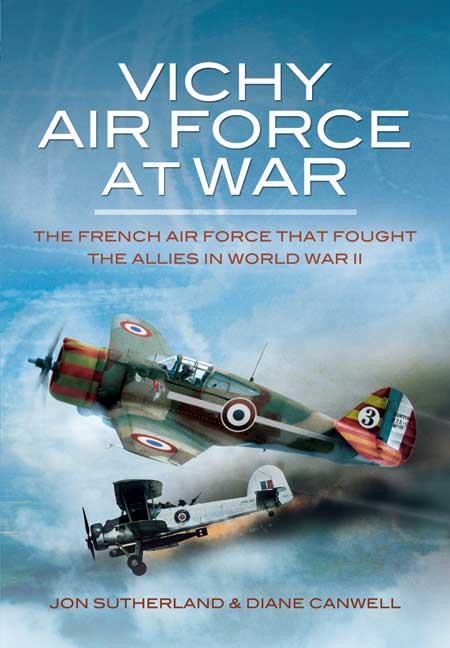
Vichy Airforce at War (book review)

 Vichy Airforce at War

By Jon Sutherland & Diane Canwell

Pen & Sword, 2011

ISBN 978-1-84884-336-3

173 pages


First off I should say I know Jon Sutherland and have communicated with him via Facebook, etc over quite a few years. He is a stalwart member of our wargames community and his figures and games often grace the pages of the glossy magazines for us all to admire and lust after. I should also add that the co-author Diane Canwell is now Diane Sutherland who`s wonderful terrain "how to`s" grace the pages of the glossies, Diane is an amazing modeller.

All this being said regular readers of this blog know I have a somewhat obsessive interest in all things French and have actively studied the conflict between Britain and her former ally (now Vichy France) after the collapse in 1940. So when Jon mentioned his book when commenting on one of my Syria/Lebanon games here, I went straight onto the internet and bought myself a copy.

The book is written is easy not to technical style over nine chapters.

The first covers the Armée de L`Air and how it was equipped and operated during the interwar era and into early WW2 up until the capitulation. This is not a period I`m particularly well read on and I found the it interesting and enlightening.

The following chapters then proceed to cover the actions of what became the French Airforce under the new Vichy Government. Each of these sections gives a near (as possible) complete record of air to air actions and losses on both sides:  

The British attack on the French fleet at Mers-el-Kébir and the abortive attempt to seize Dakar.

The rebellion by Rashid Ali in Iraq where the Vichy allowed the Germans to use airfields in Syria to send aid to the rebels against the British. Whilst I knew this I was unaware that the British attacked those airfields and there were air battles over them between RAF and French planes!  

Next we have Syria/lebanon - Operation Exporter, something I`ve read quite a bit about, but the coverage here of the airwar was very good and I learned quite a bit of new information.

After Syria we come to Madagascar - Operation Ironclad, again this book told me some things which I`d previously not known.

Finally we have Operation Torch which saw the end of the fighting between the forces of Vichy and the Allies.

The book finishes with sections on French pilots serving with the Luftwaffe and some biographical information on some of the Vichy pilots and technical info on the various aircraft.There are also appendices on the make-up of the Armée de l`Air 1940; The Vichy Airforce from September 1940; a list of victory credits for Vichy pilots; the make-up of the Vichy Airforce in Indochina and finally Aéonautique Navale (Naval air-arm).

There are also 32 pages of B/W photos illustrating aircraft, pilots, etc.

All-in-all an interesting book which added to my knowledge of this period of WW2.   

Sunday, 6 June 2021

A Strange Campaign

 A Strange Campaign

The battle for Madagascar

By Russell Phillips

ISBN 978-1-912680-27-6


First off I should say I know Russell Phillips and have communicated with him via email, etc over quite a few years usually over our mutual connection to the SOTCW, he and his family actually stayed ay our guesthouse in Swansea once too.

All this being said regular readers of this blog know I have a somewhat obsessive interest in all things French and have actively studied the conflict between Britain and her former ally (now Vichy France) after the collapse in 1940; so a new book on one of the lesser know campaigns of WW2 is right up my alley.

Now I don`t game the Far East, so even though I was aware of the invasion of Madagascar it hasn`t really been on my radar as a possible wargames project. In fact apart from Chris Buckley`s "Five Ventures" and Colin Smith`s "England`s Last War Against the French" and a very good mini-campaign about the seizing of Diego Suarez which was publish in the SOTCW Journal I`m not sure I`d ever read anything else about it!

The book is well written in an easy, not too technical style. 
It explains the reasoning and planning behind the operation, and in the appendix gives excellent orders of battle for the units involved on both sides. The various stages of the different operations are covered in reasonable depth and some quite interesting tabletop actions could be developed from the text. There are a few B/W images, but some excellent maps. 

The author also covers the political discussions and the actions of SOE on the island pointing towards these brave undercover operatives and their gathered intelligence being a huge part in the campaigns overall success.

The campaign saw several innovations which the Allies would later use in the far larger amphibious operations to come during the war. It also saw some quite interesting and varied British and Allied units involved - King African Rifles, South African armoured cars, Commandos and the only use of the Tetrarch light tank by the British in its original intended role as a light tank Vs French colonial troops including locally raised irregulars - loads of scope for the modeler and wargamer.

Overall if you have an interest in WW2 outside the usual well trodden trails I recommend this book to you. 

Sunday, 7 February 2021

Achtung Schweinehund!

After many years of literally devouring 3-4 paperbacks a week, I have for years now been unable to read fiction! Frankly there is too much "real" history to absorb my attention, history obviously is a huge part of my hobby - I don`t do fantasy or sci fi wargaming, so I guess move away from fiction books is a direct result. My holiday reading has been a large book on whatever topic I`m researching at the time. I had an interesting conversation with a server at a Bristol Airport restaurant who saw my holiday reading - a volume of Janssens` History of the Mexican Revolution, the guy was so impressed I was reading about the history of his country.

Before we finally moved out to Spain I purchased a copy of Harry Pearson`s "Achtung Schweinehund!" and now we are finally a bit more settled have spent several highly enjoyable hours out on the veranda giggling loudly at his insights and anecdotes - all of which seem aimed directly at me or people I know within our hobby...........

I highly recommended to all wargamers and hobbyists of that certain age (the Airfix generation), as you`ll probably find similar links to your own childhoods.