Project Eldest Son
A covert operation in Vietnam by Richard Baber
The original version of this article appeared in The Journal of the Society of Twentieth Century Wargamers (SOTCW)
Now as most of the regular readers here will know I`m not particularly into modern period gaming. French Indo-China and the Algerian War of Independence is about as close as I come. But that doesn`t of course mean I don`t read other more modern periods and sometimes find subjects which I then researched further as potential articles for The Journal, this is one of those.
Project Eldest Son (later known as “Italian
Green” or “Pole Bean”) was a program of covert operations conducted
by the United States Studies and Observation Group (SOG) during the Vietnam War.
The goal of the project was to replace a portion of enemy ammunition with
highly explosive and dangerous sabotaged ammunition, and thus to cause the
enemy to question the safety of their ordnance.
SOG's operators -
Army Special Forces, Air Force Air Commandos and Navy SEALs - worked directly
for the Joint Chiefs, executing highly classified, deniable missions behind enemy
lines in Laos, Cambodia and North Vietnam.
The idea of Eldest
Son came from the fertile mind of SOG's commander, 1966-68, Colonel John K.
Singlaub, a World War II veteran of covert actions with the Office of Strategic
Services (OSS). "I was frustrated by
the fact that I couldn't airlift the ammunition we were discovering on the [Ho
Chi Minh] Trail" in Laos,
Singlaub explained. It was not unusual for SOG's small recon teams - composed
of two or three American Green Berets and four to six native soldiers - to find
tons of ammunition in enemy base camps and caches along the Laotian highway
system. But SOG teams lacked the manpower to secure the sites or carry the
ordnance away. Further, it could not be burned up, and demolition would only
scatter small-arms ammunition, not destroy it.
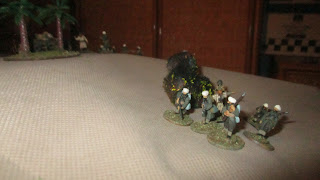
SOG team moving through the bush
Though obscure,
this trick was not new. In the 1930s, to combat rebellious tribesmen in
northwest India's Waziristan - the same lawless region where Taliban and al
Qaeda terrorists hide today - the British army planted sabotaged .303 rifle
ammunition. Even before that, during the Second Matabele War (1896-97) in
today's Zimbabwe,
British scouts (led by the American adventurer Frederick Russell Burnham) had
slipped explosive-packed rifle cartridges into hostile stockpiles, to deadly
effect.
SOG would do
likewise, the Joint Chiefs decided on August 30, 1967, but first Col. Singlaub
arranged for CIA ordnance experts to conduct a quick feasibility study. A few
weeks later, at Camp Chinen, Okinawa, and
Singlaub watched a CIA technician load a sabotaged 7.62x39 mm cartridge into a
bench-mounted AK rifle. "It
completely blew up the receiver and the bolt was projected backwards,"
Singlaub observed, "I would imagine
into the head of the firer."
Sabotaging the
ammunition proved the easiest challenge. The CIA's Okinawa lab also did a very
professional job of prying open ammo crates, unsealing the interior metal cans
and then repacking them so there was no sign of tampering. In addition to SOG
sabotaging 7.62 mm and 12.7 mm rounds, these CIA ordnance experts perfected a
special fuse for the Communist 82 mm mortar round that would detonate the
hand-dropped projectile while inside the mortar tube, for especially
devastating effect. Exactly 1,968 of these mortar rounds were sabotaged, too.
Project Eldest
Son's greatest challenge was "placement" - getting the infernal
devices into the enemy logistical system without detection. That's where SOG's
Green Beret-led recon teams came in. Since the fall of 1965, our small teams
had been running deniable missions into Laos to gather intelligence,
wiretap enemy communications, kidnap key enemy personnel, ambush convoys, raid
supply dumps, plant mines and generally make life as difficult as possible in
enemy rear areas. As an additional mission, each team carried along a few
Eldest Son rounds - usually as a single round in an otherwise full AK magazine
or one round in an RPD machine gun belt or sealed ammo can - to plant whenever
an opportunity arose.
When an SOG team
discovered an ammo dump, they planted Eldest Son; when a SOG team ambushed an
enemy patrol, they switched magazines in a dead soldier's AK. It was critically
important never to plant more than one round per magazine; belt or ammo can, so
no amount of searching after a gun exploded would uncover a second round, to
preclude the enemy from determining this was sabotage.
Lightly armed with non-standard US weapons (in this case M1 carbines)
Planting sabotaged
82 mm mortar ammo proved more cumbersome because these were not transported as
loose rounds, but in three-round, wooden cases. Thus, you had to tote a whole
case, which must have weighed more than 25 lbs.
A very clever
insertion was accomplished by SOG SEALS operating in the Mekong Delta, where
they filled a captured sampan with tainted cases of ammunition, shot it
tastefully full of bullet holes, then spilled chicken blood over it and set it
adrift upstream from a known Viet Cong village. Of course, the VC assumed the
boat's Communist crew had fallen overboard during an ambush. The Viet Cong took
the ammunition, hook, line and sinker.
In Laos, American
B-52s constantly targeted enemy logistical areas, which churned up sizeable
pieces of terrain. SOG exploited this opportunity by organizing a special team
that landed just after B-52 strikes to construct false bunkers in such
devastated tracts, then "salt" these stockpiles with Eldest Son
ammunition.
However, there
were dangers in transporting these “tampered” ammunition and in November, 1968
a helicopter carrying SOG's secret
Eldest Son team, flying some 20 miles west of the Khe Sanh Marine base, was hit
by an enemy 37 mm anti-aircraft round, setting off a tremendous mid-air
explosion. Seven cases of tainted 82 mm mortar ammunition detonated, killing
everyone on board, including Maj. Samuel Toomey and seven U.S. Army Green
Berets.
But as a result of
these cross-border efforts, Eldest Son rounds began to turn up inside South Vietnam.
In a northern province, 101st Airborne
Division paratroopers found a dead Communist soldier grasping his exploded
rifle, while an officer at SOG's Saigon
headquarters, Captain Ed Lesesne, received the photo of a dead enemy soldier
with his bolt blown out the back of his AK. "It had gone right through his eye socket!" Lesesne reported.
Sniper covering his team
Possible tabletop Scenario idea
A 5-6 man SOG team
must infiltrate to a known VC arms stash somewhere along the Ho Chi Minh Trail.
They have with them two “sealed” cans of Chinese 7.62mm ammunition each laced
with the special tampered bullets; the plan is for the team to add the cans to
the stash and then withdraw without alerting the VC to their presence.
The team must make
their way silently across the table avoiding being spotted by random VC
sentries or patrols; there is also the possibility of booby-traps (such as
pungi-sticks), any enemy must be dealt with quickly and quietly to avoid
alerting other VC elements of the teams presence. The cash itself is un-guarded
as the VC believes this area (over the border in neutral Cambodia) is safe from US attacks.
Encounter table (1 on
D6 each turn)
1
– 2 Noise
(team freeze for one turn)
3
– Wild
pig/stray dog (2 in 6 chance of the noise bringing a VC patrol to the area in
1-3 turns)
4 - Lone
VC sentry armed with SKS carbine (table 1 below)
5 - Booby-trap
(table 2 below)
6 – VC
patrol, 4 -6 men (table 1 below)
Table 1
|
Role
|
effect
|
|
1-3
|
Oblivious of
team, walks on by
|
|
4
|
You spot first
and may ambush or hide
|
|
5
|
Hears noise and
is searching (for you)
|
|
6
|
Sees you first
raises the alarm/attacks
|
Table 2
|
Role
|
effect
|
|
1-3
|
Trap spotted,
take one turn to bi-pass
|
|
4
|
Pungi-sticks
(scout spots on 4-6) *
|
|
5
|
Grenade/anti-personnel
mine (spot on 4-6) **
|
|
6
|
C4
block/claymore (spot on 4-6) ***
|
* If not spotted,
one team member gets spiked and injured; there is a 2 in 6 chance that his
scream will alert the local VC.
** If not spotted,
one team member will be killed/seriously injured by the explosion which will
bring a VC patrol to the area in 1-3 turns
*** If not spotted
entire team killed or seriously injured – game over……..
SOG
unit
Usually 4-6 US personnel;
either - Green Berets, LRRP, Marine Recon or SEALs; all men highly skilled and
motivated.
Armed with a
variety of weapons – M16, M14, Colt Commando, combat shotgun (scouts
particularly employed these), M3 SMG, AK47, M1 carbine, silenced pistols,
knives, grenades, etc.
They wore a
variety of uniforms too – US fatigues, French style “tiger stripe” fatigues and
traditional Vietnamese dress (worn to confuse the enemy); camouflage paint was
almost always applied to conceal pale skin.
For variety you
could replace US personnel with natives (ARVN Rangers/airborne, Montagnards, etc).
The VC
4-6
men armed with AK47s and/or SKS carbines and Chi-com grenades. This is a
regular local patrol sweep, these men whilst not asleep are not on high alert;
they are fully aware of their surroundings and have knowledge of all the local
trails and booby-traps/arms cashes. Once the alarm is raised other VC patrols
of similar size or larger (including LMG or RPG teams) will be drawn to the
area.
Conclusion
This type of game
is an interesting change from the usual search and destroy type scenarios,
stealth and skill being preferred to fire-power. This would work well with an
umpire controlled VC and almost a role-playing type structure for the US player
(s).
I played this game
a couple of times as a solo; in the first game - the SOGs planted their
“present”, but lost one man to a mine on the withdrawal and were forced to run
for it, pursued by the VC who never managed to make visual contact. In the
second game, twice the SOGs had to take out VC sentries before they even
arrived at the stash. A really unlucky series of roles then had the team
spotted by a VC patrol, which led to a mad chase back across the board to the
extraction point.
Whilst searching
the internet for further information on Eldest Son, I came across several
forums and chat rooms with comments on this operation during Vietnam; some of these made reference to
incidents both in Iraq and Afghanistan
where insurgent weapons “exploded”. Several of the posters wondered if
Operation Eldest Son had been resurrected?
So it occurs to me
you could transfer the whole thing to these areas with modern spec.ops. boys Vs
Taliban or Iraqis. The desert/arid terrain will create its own problems for the
team with less cover, you could also place the cash within a built up area
creating new problems with both observation and elevation issues.
Sources
I must thank Rob Morgan and his friend Lyle Hegstead for passing onto me
an article from American Rifleman magazine (May 2008) which is the basis
for this piece.
The internet provided some other useful bit and pieces –
http://www.jcs-group.com/military/war1964/project.html