Friday, 20 October 2023

Veracruz

 Veracruz

April 21, 1914

 In a direct response to the arrest of nine American sailors by the Mexican authorities in Tampico on April 9th, President Woodrow Wilson ordered the US Navy to blockade the port of Veracruz. But when it became know a German merchantman SS Ypiranga was due to arrive at the port with a cargo of weapons on or around 21st April, Wilson ordered Rear Admiral Fletcher to land troops (marines and naval personnel) to seize the waterfront and prevent those weapons (sales of which were banned) to Huerta`s troops.

The weapons had actually been sourced by John Wesley De Kay, an American financier and businessman with large investments in Mexico, and a Russian arms dealer from Puebla called Leon Rasst and not the German government, as newspapers reported at the time.

Part of the arms shipment to Mexico originated from the Remington Arms Company in the United States. The arms and ammunition were to be shipped to Mexico via Odessa and Hamburg to skirt the American arms embargo. In Hamburg, De Kay added to the shipment. The landing of the arms was blocked at Veracruz, but they were unloaded a few weeks later in Puerto Mexico, a port controlled by Huerta at the time.

So on the morning of April 21st, 502 marines of 2nd Advanced Base Regiment (ABMR from here on) and 285 sailors plus marine detachments from the battleships Florida and Utah under the command of Marine Lt. Col. Wendell C. Neville, landed by whaleboat at the quay side and moved to secure the port.

 As planned earlier, American consul William W. Canada notified General Gustavo Maass that Americans were occupying the port and warned him to "cooperate with the naval forces in maintaining order." Maass, however, was not permitted by Mexico City to surrender the port. Maass ordered the Eighteenth Regiment, under the command of General Luis B. Becerril, to distribute rifles to the populace and to the prisoners in "La Galera" military prison, and then all to proceed to the dock area. Maass also ordered the Nineteenth Regiment, under the command of General Francisco A. Figueroa, to take up positions on Pier Number Four. Maass then radioed a dispatch to General Aurelio Blanquet, Minister of War in Mexico City, of the American invasion. Blanquet ordered Maass to not resist, but to retreat to Tejería, six miles inland.

 Mexican resistance was sporadic, the untrained civilians had problems obtaining the correct ammunition and lacked any sort of organised command or supply. The released prisoners under the command of Lt. Col. Manuel Contreras did put up some kind of opposition, along with some civilians and the cadets of the Naval Academy under Commodore Manuel Azuela which eventually led to the invaders having 4 dead and 20 wounded before shellfire from US naval vessels brought resistance to an end and a ceasefire being called!

 My game assumes the order to withdraw has not been passed to all units or random groups of armed civilians, so these will try and resist the invader.

As always in my games I make no apologies for using what I have, you will note the "Marines" are just my WW1 era Yanks in Montana cap and my US sailors are the same figures who have fought for Spain, Mexico and the USA before (a mix of Russian Naval Marines and armed German sailors) just painted up to look uniform in dress.

 American landing forces

HQ

1st Company, 2nd ABMR

2nd Coy, 2ABMR

Auto weapons platoon, 2ABMR 

Composite Company of Naval volunteers

3 x 10 man platoons plus a HQ & Hotchkiss MMG 

(and yes i know they should have a Colt "Digger" but I don`t have one with a naval crew)


Mexican forces

2 platoons 19th Federal Regiment 

Split between the custom house/ammunition warehouse and the Telegraph office

Cadets Veracruz Naval Academy (start in the Naval Academy)

4 x 10 fig groups of armed civilians, plus the odd soldier


US objectives:

Custom House

Telegraph office

Naval Academy

Special rules

Mexican civilian morale is poor -1 on all checks

The cadets are young, enthusiastic and inspired by national pride so gain +1 to morale on their first morale test

The Americans can call for support fire from the USS San Francisco anchored in the harbour (3-inch gun) by heliograph any time after turn 10.


My Britannia Miniatures German armed Trawler in its early C20th guise as the USS San Francisco 

The Americans have 20 game turns to capture all three objectives failure to do so is considered a victory for the Mexican defenders (be it a pyric one).

 My table


The Harbour

North end of the harbour 

Old Mole and light house, the old Spanish gun position in unoccupied

Northern part of Vera Cruz with the Naval Academy building


Harbour and railyard

Southern part of vera Cruz 

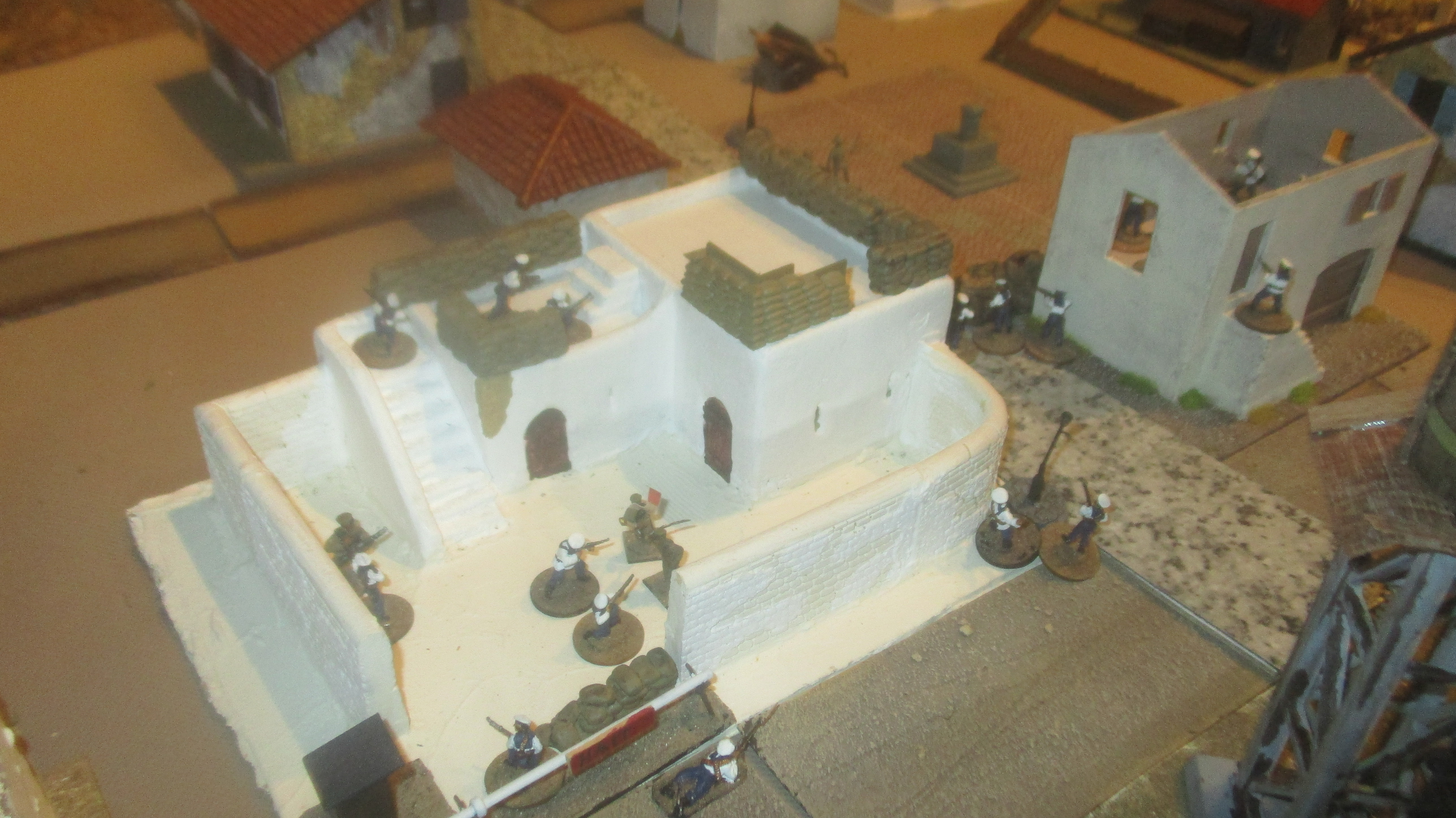
Customs Building (partially fortified)

Naval Academy

Telegraph office/Police Station


Our game starts after the initial unopposed landing, the naval company is to advance to the left through the railyard and capture the customs house, 1st Marine Company is to head up through the town to take the telegraph office and 2nd Marine Company has the task of taking the Naval Academy.

1st Marine Coy


2nd Marine Coy


Turn 2 saw the sailors filtering past the stopped train into the railyard, they come under sporadic rifle fire from the customs house and other buildings


1st Coy also pass the train heading into the town, they also come under light rifle fire (note the Colt machine gun supporting their advance)


2nd Coy moves right along the dock front towards the Academy


 Turn 3 the sailors engage with the Mexicans, they take several casualties (lucky Mexican dice), the Hotchkiss team sets-up on the flat car to give support.

1st Marine Coy find themselves under fire from a couple of buildings and move to engage.


2nd Coy keep moving right, they too take some rifle fire from the hotel and are forced to swing towards the sea out of direct line of sight.

Turn 4 sailors still exchanging rifle fire – they do cause some casualties among their opponents, then the Hotchkiss opens up taking several more – the defenders of the customs house need a morale check!

1st Marines occupy one building and prepare to storm two others, all the time being shot at and taking the odd casualty.


2nd Coy finds itself caught by a Maxim gun mounted of the Academy roof! One platoon takes cover behind the railway embankment, a second behind a building and the third tries and end run in a wide flanking move.

Turn 5 the Mexicans in the customs house fail their morale and lower their flag in surrender, the sailors rush forward to capture their prize.
1st Marine company, 1st platoon storm their target building. 2nd and 3rd platoons are engaged around other buildings.

The US Marine commander tries to contact the San Francisco by heliograph but fails!

 Turn 6 Sailors attempting to occupy buildings to the right of the customs house are fired on from a barricade up the street. The Sailors Hotchkiss team fires at the barricade in return (they cause no casualties) but I rule as the Mexicans are civilians they must make a morale check – they fail and run away…..

1st Coy, 1st platoon clear their building, 2nd Platoon clear theirs, 3rd platoon and a LMG team cover 2nd Platoon.

2nd Coy, 1st platoon move into the building they are sheltering behind, from there they can fire upon the hotel across the street


The Marine HQ contacts the San Francisco, but the ships gun crew don`t spot the Maxim gun………

Turn 7 the sailors now occupy the customs house and nearby buildings.

1st Coy, 1st platoon move out of their building towards the hotel (yes I know this wasn`t their orders, but hey Marines are expected to use their initiative).

2nd Coy, 1st platoon bring fire onto the hotel causing casualties upon the Mexican Naval Cadets defending the building.

2nd platoon is still pinned by the Maxim, 3rd platoon move into position to attack a building further to the right.

The San Francisco finally spots the Maxim but its first shell drops short

Turn 8 1st Company, 1st platoon storms the hotel as does half of 1st platoon, 2nd Company under the command of 2nd platoons commander, what was left of the cadet defenders surrender.


2nd Company, 3rd platoon storm the house opposite the Academy gates, again the remaining defenders surrender……..

Once again the San Francisco fails to find its target when firing at the Maxim.

Turn 9 begins with the Americans in full control of the dock front and all buildings.

The sailors fully occupy the customs building and surrounding buildings.


The San Francisco finally lays a shot on target wiping out the Maxim


2nd Marine Coy move to storm the Academy


1st Marine Coy supported by the Colt MMG begin their advance towards the telegraph office.


Turn 10 The San Francisco again lands a shell on target onto the Academy, this combined with 2nd Marine company`s wild charge forces a morale check among the remaining cadets – they fail badly and surrender.


1st Marine Coy work their way through the town, they exchange fire with both civilains and Mexican troops concealed among the buildings or firing from rooftops.


Turns 11 to 13

2nd Marine Coy secure the Academy and form a defensive cordon


1st Marine Company fight their way towards the telegraph office, they take casualties, but the Mexican civilians morale is fragile and upon losing men the groups usually break off and run away or hide.

Fleeing civilians try to take shelter in the telegraph office

 Turn 14 the Marine machine guns sweep Mexican defenders off the rooves, this causes a morale check among the survivors – they fail (badly).

 Turn 15 1st Platoon, 1st Marine Company storms into the telegraph office courtyard – surviving Mexicans surrender.


 Victory to the US forces, all objectives captured within the required time-scale. Casualties were a bit higher than the real incident, this is down to a number of factors – lucky dice mostly! On the whole I`m happy how the game ran, but since setting this one up I`ve found a better map among my notes and the table isn`t accurate, so I may re-set the table and try again.      


Wednesday, 13 September 2023

The Blue Squadrons in Russia (new info added 13/09/23)

 The Blue Squadrons

Spanish Volunteers with the Luftwaffe on the Eastern Front

By Richard Baber with additional information from Phil Gray

An earlier version of this article appeared in the Society of Twentieth Century Wargamers (SOTCW) magazine The Journal

When Franco despatched his volunteers for the “Crusade against Bolshevism”, who formed the 250 Infantry (or Blue) Division of the Wehrmacht, he also authorised a volunteer air force to take part in the Crusade. This force, of squadron strength, would fight with the Luftwaffe as the 15th (Spanische) Staffel of JagdGeschwaders 27 and 51, leaving Spain on June 25th 1941 and finally returning in April 1944. To the Spanish it was known as the Azul Escadrilla, the Blue Squadron. It should be noted that whilst the Spanish Volunteer Blue Division was just one of 135 German Divisions at the time in Russia, their volunteer squadron was one of just fifty fighter squadrons!

The  Squadron's emblem - the motto is "Vista suerte y al toro".

The First Blue Squadron

The First Squadron, 130 men including 17 pilots, commanded by Commandante Angel Salas Larrazabal left Spain on June 25th 1941.  These pilots had shot down a total of 79 Republican aircraft between them and were familiar with Me109 fighters.  Even so they were made to go through Luftwaffe instruction on the type in Germany, which took until September 1941.

By September 26th the Squadron was operational, flying their Me109E-7s from Mozhna airfield near Minsk, on the Central Front, as the 15th Staffel of Jagd Geschwader (JG) 27 in Luftflotte VIII, under Wolfram von Richthofen, himself a veteran of Germany’s Condor Legion. The Squadron commander, Comandante Larrazabal was awarded the Iron Cross 2nd Class for his action in shooting down an I-16 fighter and Pe-2 reconnaissance bomber in October 1941.

“I saw coming 6 Pe-2 and I went after them, cutting the distance between us I found myself below I opened fire from 150 meters with my small machine [guns?] and much closer with my canons, I saw pieces jump from the aircraft after the second burst, it occupant taking to his parachute. Later I continue towards Cholm to join up with the group and see a ‘Rata’ I attack him in a turn while trying to flee in a fast dive that rips his left wing and he crashes near the confluence between Dnieper and Wjasna. Later I attack twice another ‘Rata’ with no effects.”

Larrazabal’s own account of the action.

http://www.elknet.pl/acestory/larrazabal/larrazabal.htm

The squadron was, for the most part, denied the “free hunt” missions that would have offered the best opportunities to engage the Soviet VVS, and was instead ordered to fly low level attack missions in support of German forces in Army Group Centre.

 As Army Group Centre advanced so the Squadron moved further East to support its operations, moving as far as Klin, and then, in the face of the Soviet Winter offensive, falling back to Vitebsk.  The squadron was relieved on January 6th 1942 and returned to Spain in February, having flown 460 missions and claimed 10 enemy aircraft in air to air combat, and four destroyed on the ground in exchange for five of their own pilots, including Commandante Jose Munoz Jimenez, Deputy Squadron Commander and Captain Aristides Garcia Lopez (who was reported missing in November 1941), Lopez was a SCW ace having 18 kills to his credit during the war.

This photo shows a group of Nationalist pilots Captain Lopez in the centre

Lopez in the cockpit of his Me109 as part of the 1st Blue Squadron

  Six of the 10 aircraft shot down by the 1st Squadron and two of those destroyed on the ground, were credited to the Squadron Commander Larrazabal, making him an ace in both the Spanish Civil War (where he shot down 17 republican aircraft) and the Second World War.

The Second Blue Squadron

 The Second Squadron under the command of Comandante Julio Salvador with Squadron commander being Capt. Antonio Noriega Labat. The squadron was formed in Spain on February 6th 1942, and underwent similar training in Germany to the First Squadron did not become operational till June 8th and was assigned to JG 51 as its 15th Staffel, flying the Me109F-4 - better armoured and with faster firing cannon than the Me109F-2 that their German counterparts in the rest of the Geschwader were still flying at this time. The Squadron was not directly involved in Fall Blau but was used around Orel, the boundary with Army Group Weichs. By November 30th 1942, when they were relieved, they had flown 403 sorties, shooting down 13 Soviet aircraft for only two losses. One of these loses was Captain Noriega Labat (shot down on 3rd July 1942), in his honor the squadron add a slogan Black 1 of 2nd squadron "Capitan Noriega Presente".

 The Third Blue Squadron

 The Third Squadron, commanded by Comandante Carlos Ferrandis Arjonilla, began its tour on December 1st 1942.  It was short of pilots so six of those from the Second Squadron remained with it temporarily.  It was an inauspicious start, as Capt Andres Asensi Alvares-Arenas was shot down and taken prisoner on the first day of its operations. 

Atrocious weather conditions provided limited flying opportunities, and the Spaniards scored only two victories until January 27th 1943, when they successfully shot down seven Soviet aircraft.  Operations were still sporadic, with 11 victories claimed between 22-24 February and seven more between 7 and 10 March, flying Me109G‑2s and G‑4s as the 15th Staffel, JG 51 – it was only in March that the remaining Third Squadron pilots joined the unit, allowing those six that had stayed on from Second Squadron to finally return to Spain

The Luftwaffe decided to re-equip the Spaniards with the new FW190A-3 fighter in March and they became operational on the type by April 25th 1943, and so were able to take part in the aerial battles that preceded the battle for Kursk.  The Third Squadron was officially relieved on July 8th 1943, having scored 62 aerial victories (29 of them with their new FW190s) and without losing a single Ju87 from the formations they had escorted.

 The Fourth Blue Squadron

 The Fourth Squadron began to replace the Third in July 1943, again the pilot complement was incomplete and some of the Third Squadrons ‘old hands’ stayed with them, under Comandante Mariano Cuadra Medina.  The squadron was based at Seschstsniskaya, to the South‑East of Roslav

 The squadron had arrived just in time for the last great German offensive in the East, and, with the rest of the staffeln in JG51 and JG54, bore the responsibility providing fighter cover for Generaloberst Walther Model’s 9th Army attacking the North of the Kursk salient. The intense fighting is reflected in the Squadron’s operational record: although only officially operational for three weeks in July they flew 391 sorties, and shot down 12 Soviet aircraft, in August they shot down 21 and in September another 15.  These victories were scored over the latest Soviet types, the Il2m3 tank busting Sturmovik introduced for Kursk, and the Lavochkin 5 and 7 fighters. 

 On at least two occasions the pilots of the Blue Squadron had the opportunity to renew old acquaintances in the air as they fought against Spanish fighter pilots flying in the VVS. 

 Although the Blue Division was withdrawn from the Eastern Front, to be replaced by the Blue Legion brigade sized formation, at Franco’s command in October 1943, the Blue Squadron was allowed to remain with JG51, staying until January 1944.  By the time they were withdrawn they had scored some 52 aerial victories, and 22 destroyed on the ground, but at significantly higher cost to Spain – seven of its 20 pilots had been killed in action (including 8 victory ace Sen Lt Sanchez‑Arjona) and three of the remaining 13 were badly wounded.

 The Fifth Blue Squadron

 The Fifth Squadron, under Major Murcia Rubio completed its training on FW190s in early February 1944, and within a couple of weeks, was active on the Eastern front, albeit flying Me109G-6s!  Political pressure from the Allies forced Spain to recall its forces from the Eastern Front, the Blue Legion being ordered back on March 6th and the Blue Squadron in April - the Fifth Squadron still managed to fly 86 sorties, fight six aerial engagements and lose one pilot though.

The Blue Squadron’s Record

Between them the five Blue Squadrons had brought 89 Spanish pilots into action with the Luftwaffe, flown over 3000 operational sorties, including 606 aerial engagements, resulting in the shooting down of 159 Soviet aircraft the loss of 23 of the 89 pilots - 18 killed in action, 2 missing in action and 1 POW, a loss rate over 25% of the 89 pilots committed.  The Spanish airmen never did get to fly in support of their Spanish compatriots in the Wehrmacht.

Gaming the Blue Squadron In Action

Depicting the Blue Squadron in action is relatively straight forward given its use of German aircraft types.  Aside from the unit emblem shown in Figure 1 these aircraft are marked identically to those of the German staffeln in the same Geschwader. 

Aside from the battles around Kursk and its aftermath – the time of the First, Second and Fifth squadrons, the Spanish were most often tasked with either low level ground attack or escort missions in support of German ground and air units.   The Third Squadron was faced by a resurgent VVS keen to disrupt German preparations for the Kursk battle, and the Fourth by a further reinforced VVS contingent – the 1st and 16th Air Armies – over the battlefield itself.

A&A Game Engineering’s “Scramble” rule set covers all these mission types in some detail, and will allow you to distinguish between ace and novice pilots on both sides, while fielding the whole of the Azul Escuadrilla in action if you wish.

“Airforce” covers the distinctions between fighter types and air to air combat in great detail, The Blue Skies rule set module “Red Star Blue Sky” concentrates on low level battlefield interdiction and has the stats for the aircraft involved.

While the contribution of Franco's Nationalists was made as a contingent the former Republican pilots who flew with the VVS were scattered across the VVS fighter regiments.  However at least four aces, Vicente Beltran, Antonio Aras, Antonio García Cano and José Pascual Santamaria (killed 1942), flew together in 283 Fighter Regiment (IAP) when the war broke out. 283 IAP was initially equipped with MiG 3 fighters. Both Arias and Santamaria were aces in both the SCW and Great Patriotic War.

Sources:

  1. In the Skies of Europe, Hans Werner Neulen
  2. Axis Europa magazine issue 17, spring 1999 has a good article of the Blue Squadrons

  3. https://www.lasegundaguerra.com/viewtopic.php?t=3642