La Montee
Mechanisation and the Foreign Legion in the 1920s/30s
An earlier version of this article appeared in The Journal of the Society of Twentieth Century Wargamers (SOTCW)
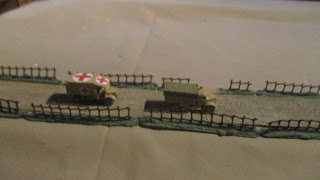
VUDB carriers by Early War Miniatures from my collection
The first unit of the Foreign Legion to be
motorised/mechanised was VI escadron 1REC (Regiment Estranger Cavalry) in
February 1929. The unit composed of men drawn from the two squadrons of the
regimental depot company at Sousse,
Tunisia. The
new mechanised unit was under the command of Captain Dugas, with most of the
junior officers and NCOs taken straight from line light cavalry armoured car
units from France.
In the summer; Captain Tavernot’s V escadron was also
ordered converted to motorisation; unfortunately both units found equipment
slow to arrive. Also in the 1920s driving was not the universal skill it is
today, very few men had any experience, so all the men were sent, one troop at
a time to Meknes
on a six week basic course in driving and maintenance. After the first troop,
commanded by Lieutenant Lennuyeux finished their course they were ordered to
drive back to Boudenib (a distance of 250 miles); their transport was to be
five big, but underpowered Berliet trucks and a single White armoured car. The
journey was supposed to take only four days, but the vehicles were totally
unsuitable for dusty, hot Moroccan roads! Eight days later, the sorry
procession staggered into Boudenib with the first truck towing the second; the
third towed the White and the forth coughed and spluttered along on its last
legs; fifty miles back the last truck had finally broken down and had to be
abandoned, not a great start……
Ten days later, the “alert platoon” was called upon to
support a Goumier unit chasing a raiding party south. Engine trouble delayed
their departure by over two hours and when they finally caught up with the
Goums, the vehicles just couldn’t handle the rough going and the Goumier left
the cursing Legionnaires far behind struggling with their metal horses……
The man given responsibility for the transformation of the
Legion’s mounted and mule companies to motorisation was Colonel Georges Catroux.
The first of the mule companies to make its transition was
Captain Robitaille’s 2nd (mounted) / 2nd REI (Regiment Estranger
Infantry) in 1930. At first they got only trucks, but in November, they
received four Berliet VUDB armoured carriers; their designation was changed to
2nd (motorized), but all but the first platoon was still mule mounted!
The overall plan was for REC squadrons to have one troop of
turreted armoured cars; one or more mounted in armoured carriers and the rest
motorised in trucks. The new Montee companies of the REI were to be similar in
organisation and were also to include an armoured car platoon. Unfortunately in
those early days there was no standardisation; units found themselves operating
different types of vehicles simultaneously, most were totally unsuitable for
the climate or terrain of southern Morocco/Algeria! A constant headache for the
mechanics who struggled to keep them running and the quartermasters who had to
keep those mechanics supplied with parts!
By the summer of 1931 Robitaille’s unit had been transferred
to Sud-Oranais and had been re-titled – Motorized Company / 1st REI, it had a
new established TO&E –
White armoured car
Laffly armoured cars
Laffly armoured cars
Armoured car platoon
4 x old White armoured cars
Light platoon
5 x VUDBs
Half company
120 men carried in 14 Panhard 179 armoured carriers
Panhard 179 APCs
Its workshop unit also had to maintain a variety of soft
skinned support vehicles too.
By 1934, VI escadron 1REC had also been re-organised –
A/C troop
3 x Laffly 50AM
3 troops
Each of 5 x VUDB
Amazingly even now it had a soft-skinned inventory with no
less than ten (10) different makes and models of cars and trucks!!
Breakdowns were frequent, and keeping numerous spares in
store in remote desert bases was a logistic nightmare; particularly as these
were at the end of already over long supply-lines! Thankfully the legionnaire’s
traditional (almost legendary) ingenuity was the saving grace; knocking up bits
and pieces in local blacksmiths, building odds and ends from the most
outlandish items, etc.
The Berliet VUDB “Vehicule
de prise de contact” was a truly awful piece of kit – a slab-sided steel
van, too tall, too heavy even when empty (4.9 tons) for it’s puny 40hp engine;
an over complex “advanced” four-wheel drive system and an incredibly sort range
(only 125 miles) considering the requirements of the unit! One can only imagine
bumping along a rough desert track, crammed inside a steel box with your mates
and all your gear in temperatures as high as 70 degrees!!

There was some conflict within the Legion between
traditionalists and modernisers. The former cavalrymen or mule riders would
complain about these dead, cold iron beasts Vs their boon (living) companions.
When in March 1932, VI / 1REC completed a Saharan round trip patrol of 1,570
miles in 55 days, veterans would point out (ignoring the impressive mechanical
achievement), that mounted companies had been surpassing this average 29 miles
a day on patrol for the last 50 years! The squadron’s armoured cars were
already subject to a cruel act of fate when in May 1930, a sniping tribesman
with amazing luck put a round down the barrel of a White TBC, which
unfortunately had its breach open! The resulting ricocheting, injured not one
but two of the crew!!
Oasis Meski, January 18, 1932
Capt. Robitaille’s Motorised Company 1REC are part of General Giraud’s mobile
column sent to pacify the Rissani tribe in southern Talfilalt. The oasis is
situated 35 miles up the Zis
Valley; an old kasbah
surrounded by small village in the centre of palm and date groves.
Robitaille’s unit was reinforced with a couple of portee 37mm
trench guns mounted Berliet trucks. the basic plan was for the infantry in
their Panhard carriers to advance, supported by the armoured cars and the guns,
the truck born elements were then to dismount and advance to contact.
Unfortunately the first Panhard 179 bogged down blocking the
track some 400 yards short of the village. All the infantry therefore were
forced to dismount and advance on foot through the palm groves under whatever
limited support fire the other vehicles (now stranded) could provide. The palm
groves were strewn and obstructed with fallen trunks and cactus hedges, the
advancing squads under constant fire from Kasbah towers. First platoon advanced
until they reached the Kasbah, where they were stopped by it’s large heavy
gate; thankfully some of their comrades had man-handled a 37mm across the palm
groves and were then able to blow the gateway open. A vicious one-hour battle
followed, resulting in the village surrendering to the French; it cannot be
said the Legion’s new equipment added much to this action……..
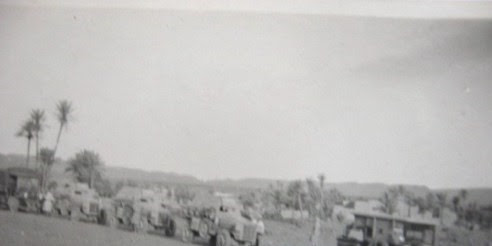
Blurry photo showing at least three VUDBs plus odd support trucks
French/Spanish frontier, February 1934
One of the last hold-out areas in Morocco
was in a far south west towards the border of Spanish
Sahara. This vast area of very dry desert was sparsely populated
and would have been of little interest of concern to the French authorities,
except a few thousand Berbers of various factions, tribes and clans had slowly
moved to take refuge in this last un-policed corner.
General Hure’s plan called for a large sweep using all
available mechanised and mounted units supported by aircraft and ample
artillery; using several fast moving converging columns to create a great bag
with the remaining rebels trapped inside. The key unit in the plan was Colonel
Teinquet’s mechanised force which was to advance as fast as possible and form a
stop-line to prevent the dissidents from fleeing across the frontier into Spanish Sahara.
This was in fact the first French experiment with a light
armoured or mechanised brigade, operating independently. The force consisted of
– three armoured car squadrons of 1RCA (Regiment Chasseurs d`Afrique); two
mechanised squadrons of 1REC and the motorised companies of 1st and 4th REI.
Around 100 armoured vehicles and 350 supporting soft skins!
Citroen C3 half-track
The operation began on February 21st with columns spreading
out across the desert, there were some minor skirmishes, but the bulk of the
dissidents tried to flee south. The race ended at a place called Mechra Chamnar
where Captain Marion’s V escadron 1REC had actually sent a couple of troops across
the frontier in a long sweep before heading back northwards. This move
convinced most of the dissidents that even crossing the frontier wouldn’t make
them safe, so they capitulated.
In 18 days Trinquet’s units had covered nearly 1,100 miles,
and this first test of a wholly motorised brigade was judged a success,
although their repair trucks had used up more than seven tons of spares – 25%
of the Laffly armoured cars and 60% of the fragile VUDB carriers had suffered
mechanical breakdowns!
With the end of open hostilities the French (and the Legion)
settled down to police their colony, the open true Sahara spreads out south of Algeria and Morocco, home to camel riding
tribes who owe fealty to no monarch or government. This vast region was only
lightly patrolled by French Saharienne camel mounted units and it was to
support these, the two motorised companies of the Legion infantry regiments
were sent. Motorised Company 1REI went to Tabelbala in Algeria and CMA / 4REI (CMA – Compagnie
Automobile Mobile) ended up in Foum el Hassane in Morocco. These units had truly vast
patrol areas, in the case of CMA / 4REI, the 284 men had an area of 100, 000
square miles of the Western Sahara; their patrol circuit “tournees de police” was over 2,000 miles - roughly the distance of
London to Naples
and back!
Both units cooperated on sweeps and reconnaissance missions
with camel mounted Groupe Nomade de la Mauritanie and the Compagnie des Confins
Algero-Marocains
In 1935, CMA / 4REI was organised as follows –
Two-squad HQ
Four-squad workshop platoon
A general service four-squad platoon (assigned as required
by the captain)
A two-squad armoured platoon with Panhard 165/175 armoured
cars and Panhard 179 carriers
Four squads of motorised infantry in 2.5-ton Laffly LC2
patrol trucks
The unit also had:
Four Renault field cars (equipped with cork roofs,
double-radiators and extra fuel tanks)
Fuel tankers, a workshop truck and a radio car
Panhard 165/175 armoured cars
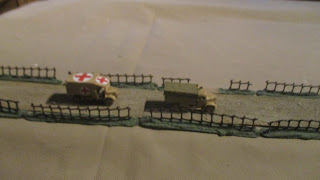
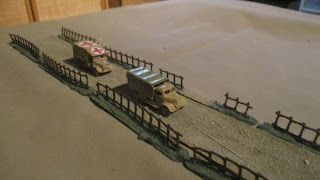
Di-cast between the wars transport from my collection
Scenario
Investing Tauoz 1930
After
seven years of patrolling the French closed in upon the last rebel held area
around the town of Tauoz.
A sizeable build up of forces began which included two companies of Compagnie
Saharienne (camel corps), four companies of Moroccan Tirailleurs (riflemen)
plus elements of 1REC (Legion cavalry) and elements of 4REI (legion infantry)
which included a composite battery of 75mm guns. A plan was formulated to
envelope Tauoz with several columns in order to prevent the rebels from evading
and slipping away to fight another day.
As
with many of these obscure colonial battles there is little easy to find
documented information. But I did find a fairly detailed and interesting
account of one small column from 1REC and thought this would make an
interesting skirmish scenario.
Scenario
You
are a subaltern who commands a troop of 3rd escadron 1REC stationed in southern
Morocco,
for the past three years you have led your troop learning from the experienced
NCOs the ways of the desert. All through your tour the rebel stronghold of
Tauoz has been a constant threat to operations, a bolt-hole for the dijicheur
(bandits) abandoned by the French back in the early 20s when the Rif exploded. Now a major offensive is being organised to
retake the town and your unit is to play a role. All your adult life you’ve
wanted this, to be part of a legion column and to take the battle to the enemy.
Unfortunately your troop has to leave their horses behind and become motorised;
your transport has been provided by Saharan Special Transport Company with
seconded legion drivers. The plan calls for your troop along with a troop of
armoured cars are to move around the flank and seize the oasis and native
village at Ouzina which is south of Tauoz, a squadron from the Camel Corps will
be moving north to link up with you.
Legion force
1 officer – Lieutenant
Vaudreuil
39 men carried in 4 lorries
(carbines, pistols, and one grenade each, the troop has a Lewis LMG)
Things
go pretty smoothly until the fifth day when one of the A/Cs breaks down beyond
all hope of repair. The next day a second car gives up, each three-man crew
joins the cavalrymen aboard the now very full lorries. Two days later and the
column is now within striking distance of Ouzina when one of the lorries falls
into a ravine, this puts fifteen of the legionnaires on foot. Fortunately these
men are hardened to the desert and the commander knows that the oasis is only a
days march away. As darkness approaches the column headed for an outcrop of
rock to shelter for the night.
Orders your column is now nearly at its objective, with
fifteen men now on foot you decide to laager near at an outcrop of rocks for
the night and attack Ouzina tomorrow. The light is fading as your trucks and
armoured cars approach the rocks; all is quite until a dozen rifles open up on
you from the rocks, you’ve run into a Druse ambush! A lucky shot amongst the
first volley strikes the lead trucks gas tank and the vehicle bursts into flame
illuminating you to your enemies. The armoured cars cannot aid you except for
inaccurate cover fire as the enemy is concealed in the darkness. It’s up to you
and your legionnaires to seize the high ground the old fashion way.
A
couple of men are already casualties so you quickly split your command into
four parts:
1. The armoured cars and spare crewmen and drivers to
remain with the trucks and supplies and provide some cover fire.
2. Corporal Gutsche with 7 men to the left.
3. Troop-Sergeant Senez with 9 men to the right.
4. You with the remaining 15 men and the Lewis gun up the
middle.
The
troop charged up the rocks and threw themselves into cover, returning the Druse
fire. This turned into a bitter skirmish between to well disciplined Legion
troops and their skilled enemy. The Druse attempted to infiltrate and envelope
the legion positions and engage in hand-to-hand combat which resulted in a
number of fatalities. Just when things were looking grim a series of signal
rockets were seen to the south, the Camel Corps unit had arrived drawn by the
sounds of battle. At the arrival of these reinforcements the Druse withdrew to
avoid being killed or captured.
Druse ambushers
Up to 25 warriors armed
with rifles, muskets, swords and knives (don’t arm every Berber with a gun,
allow for hand-to-hand)
At
this point the account ended, At a rough count at least nine legionnaires were
killed and another three wounded, Corporal Gutsches section was wiped out. The
Druse lost at least twelve warriors. This action seems well balanced for a one
to one skirmish. Even though the account ended here the French could still
continue their mission and attack Ouzina.
Ouzina is a small oasis village made up of 10-15
mud-brick Arab style houses built near to the life giving water source. The
oasis is not like the movies but a deep cut hole in the ground although there
will be date palms and thick desert grasses. The village is enclosed on three
sides by a 4-6 foot high embankment and to the north by a 30-foot rough cliff
of natural rock. There is also a coral for horses and camels and pens for the
village goats and sheep. The French attacker should work out a plan of attack
in order to prevent any Berber warriors escaping to fight another day.
Available French forces
Saharan company
(camel corps)
Coy HQ (CO, 2IC, senior
NCO, 12 men)
3 troops 25 men each
(carbines & grenades)
Legion column
3 armoured cars (Hotchkiss
MG)
The remains of Legion troop
after ambush carried in 2 lorries
Ouzina defenders
30-50 warriors armed with
rifles or muskets, swords and knives
This
period and theatre of the twentieth century still offers opportunities for the
wargamer. The technology that dominated the Great War battlefields, the machine
gun and artillery could not be used to effect against a mobile and elusive
enemy.
Sources
The Bugle Sounds – Major Zinovi Pechkoff
French Foreign Legion 1914-1945 – Martin Windrow & Mike Chappell
Our Friends Beneath the Sands – Martin Windrow
The Conquest of Morocco – Douglas Porch
The French Foreign Legion – Douglas Porch
My Life in the Foreign Legion – Prince Aage of Denmark
The Conquest of the Sahara
– Douglas Porch
France, Soldiers and Africa
– Anthony Clayton
In Morocco
with the Legion – G. Ward Price
March or Die – Tony Geraghty
The French Foreign Legion – Erwan Bergot
Les Chasseurs D`Afrique – Jacques Sicard & Francois
Vauvillier
Legionnaire – Jacques Weygand
The Foreign Legion – Patrick Turnbull